"Their expertise in structural design and engineering is truly outstanding. They delivered innovative drawings and calculations, ensuring safety, structural efficiency, and total cost-effectiveness."
Structural Sense provides statutory structural stability certification across Chennai. Led by CMDA Registered Structural Engineers. We inspect on-site and issue legally valid Form A, B, and C certificates under the Tamil Nadu Public Buildings Act and Form 1A/2 under the Factories Act. Sound buildings receive direct certification within 48 to 72 hours. Distressed structures receive calibrated NDT scans and verified repair blueprints.
Legally valid Form A/B/C & Form 1A/2 certificates signed by CMDA Registered Structural Engineers
Government departments, municipal corporations, and regulatory boards require structural stability certification for legal operation, safety clearances, and annual license renewals.
Mandatory compliance for new factory plan approvals, equipment layout changes, and triennial license renewals under the Tamil Nadu Factories Rules.
Statutory soundness certification under the Tamil Nadu Public Buildings (Licensing) Act 1965 for educational boards, universities, and healthcare facilities.
Mandatory engineering documentation required by Tamil Nadu Fire & Rescue Services (TNFRS) and corporate property insurers for high-rise commercial assets.
Municipal safety audits for residential apartments and commercial structures crossing the 15 to 20-year age mark in Greater Chennai Corporation limits.
We follow a transparent, four-step evaluation process: our CMDA Registered Structural Engineers inspect your building on-site, issue certificates directly if sound, or provide calibrated testing and retrofit plans if distress is observed.
Our CMDA Registered Structural Engineer visits the premises to conduct a comprehensive visual audit across all columns, beams, slabs, shear walls, and foundation interfaces.
Initial AssessmentStructure is in Healthy Condition: If no structural distress, alarming cracks, or settlement are found, we verify framing and issue the official Stability Certificate directly within 48 to 72 hours.
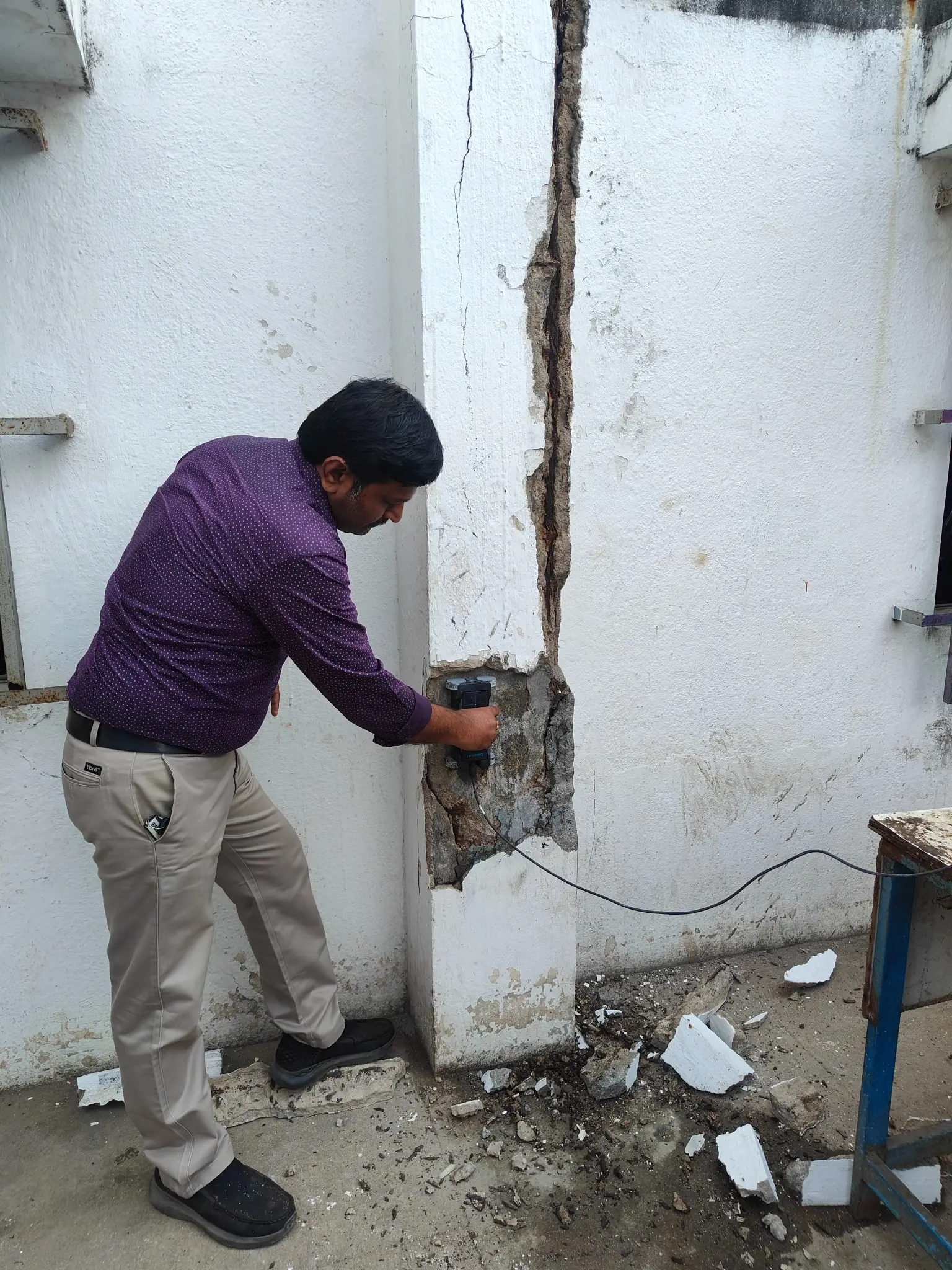
Direct Certificate IssuedDistress or Defects Observed: If cracks, spalling, deflection, or rebar corrosion are detected, we suggest targeted NDT testing and design surgical retrofitting solutions.
Diagnostic & Repair PlanAfter the client completes recommended strengthening measures, our engineer verifies executed repairs and issues the final statutory Stability & Safety Certificate.
Final Statutory SealIncludes physical site inspection by CMDA Registered Structural Engineers, framing evaluation, statutory form preparation (Form A/B/C or Form 1A/2), and official engineer seal. Final fee depends on built-up area and asset type.
Structural stability cannot be determined by visual aesthetics alone. Our CMDA Registered Structural Engineers conduct rigorous, multi-point evaluations across all primary load-bearing members in accordance with IS 456:2000 and the National Building Code (NBC 2016).
We inspect ground plinths, basements, and grade beams to identify differential soil settlement, coastal water table seepage, and capillary moisture damage.
Columns carry the entire dead and live loads of your building. We check for vertical compression cracking, concrete cover delamination, and column-beam joint distress.
We evaluate flexural sagging, mid-span deflection, ceiling hairline cracks, and support shear cracks caused by heavy floor loading or equipment vibration.
In Chennai's humid coastal climate, chloride ingress causes internal steel rust. Rusted rebar expands up to 600%, cracking external concrete covers.
For industrial factories and warehouses, we evaluate machine resonance, stamping press impacts, crane gantry rail alignments, and roof truss connection bolts.
We review unauthorized load additions, such as newly constructed upper floors, commercial rooftop solar panel arrays, or large overhead water storage tanks.
A static commercial office experiences vastly different stresses than a manufacturing plant with heavy vibrating machinery. Our structural stability audits are tailored to your sector's operational realities.
Audits designed to evaluate heavy dynamic machinery loads, crane gantry vibrations, floor slab deflection, and chemical corrosion in manufacturing plants.
Verifying structural soundness for high-occupancy corporate towers, IT parks, and retail malls, specifically addressing tenant alterations and vertical expansions.
Rigorous safety checks for schools, colleges, and hospitals where occupant protection is paramount and tolerance for structural distress is zero.
We deliver a comprehensive, legally vetted engineering dossier that satisfies statutory inspectors, corporate boards, and insurance underwriters.
The official legally binding certificate (Form A/B/C for Public Buildings or Form 1A/2 for Factories) signed and sealed by our CMDA Registered Structural Engineer.
A comprehensive visual and photographic structural assessment documenting framing integrity, defect mapping, and conformity with IS 456 / IS 1893 codes.
If structural defects or distress are identified, a complete NDT concrete test package and verified retrofitting completion sign-off are included.
Government departments, municipal corporations, and licensing bodies mandate specific statutory forms depending on building use. Here is the legal breakdown for assets in Chennai and Tamil Nadu.
| Form & Act | Applicable Facility Type | Governing Authority | Validity Cycle | Key Engineering Focus |
|---|---|---|---|---|
| Form A TN Public Buildings Act 1965 |
Schools, Colleges, Universities, Hostels, Auditoriums | District Collectorate & Education Boards (CBSE/State) | Annual or 3-Year Renewal | Foundation safety, stairwell exit widths, ceiling slab load limits |
| Form B TN Public Buildings Act 1965 |
Hospitals, Nursing Homes, Theatres, Commercial Halls | Department of Public Health & Greater Chennai Corporation (GCC) | 3 Years | Technical structural statement, live load capacity, emergency egress |
| Form C TN Public Buildings Act 1965 |
All Public Buildings Requiring Commercial Operational License | Tahsildar & Executive Magistrate | 3 Years | Official legal Certificate of Structural Soundness under the seal of CMDA Registered Structural Engineer |
| Form 1A & Form 2 Factories Act 1948 |
Manufacturing Plants, Warehouses, Industrial Bays, Chemical Units | Directorate of Industrial Safety and Health (DISH) | 3 Years | Crane gantry vibrations, heavy machinery dynamic loads, roof truss stability |
| Fire NOC Clearance TN Fire & Rescue Services |
High-Rise Residential Apartments (18m+), IT Parks, Malls | Tamil Nadu Fire and Rescue Services (TNFRS) | Annual / Periodic Renewal | Structural framing fire rating, evacuation route integrity, terrace tank loads |
Certificates are signed and sealed by CMDA Registered Structural Engineers recognized across Chennai Corporation, CMDA, and District Collectorates.
For buildings in healthy condition, we expedite on-site inspection and issue statutory documentation within 48 to 72 hours to prevent license delays.
If inspection reveals concrete cracks, deflection, or rebar corrosion, our strengthening division delivers targeted NDT scans and micro-concrete repairs.
To ensure quick turnaround and seamless approval by statutory authorities, having key documentation ready helps expedite the audit process. Missing drawings? Our engineers reconstruct framing layouts using on-site non-destructive scanning.
Original architectural plans and local body planning permissions help verify authorized built-up areas and permissible occupancy limits.
Engineering blueprints detailing column sections, beam sizes, concrete grades, and reinforcement schedules accelerate calculation verification.
Administrative and statutory documentation required to cross-verify building ownership, operational tenure, and licensing category.
The Situation: An automotive component manufacturing facility in the Chennai industrial corridor faced an impending factory license renewal deadline. The facility operated 24/7 with heavy stamping presses and crane gantries.
The Intervention: We conducted an initial on-site visual audit. Upon observing localized slab vibration near stamping bays, we recommended precision NDT testing and targeted micro-concrete jacketing. Once repairs were completed, the final Form 1A/2 certificate was issued within 48 hours.
Comprehensive breakdown of Form A/B/C, Factories Act mandates, inspection procedures, and CMDA compliance.
Complete statutory audit guide for aging apartments, commercial towers, and factory bays facing GCC municipal notices.
How non-destructive testing provides accurate concrete compressive strength and steel corrosion data without drilling.
Our statutory structural stability certification starts from ₹25,000 + GST. The exact quotation depends on the total built-up area (sq.ft), building age, occupancy category (residential apartment, school, commercial high-rise, or industrial plant), and whether structural distress requires additional calibrated NDT testing.
For buildings in structurally healthy condition, our registered engineer completes the on-site audit and issues the statutory certificate within 48 to 72 hours. If defects, cracks, or corrosion are identified during inspection, turnaround depends on executing recommended strengthening measures before final sign-off.
Our process is straightforward and transparent:
1. Visual On-Site Audit: Our CMDA Registered Structural Engineer conducts a physical inspection of all load-bearing members.
2. Direct Certification (If Sound): If the framing is sound with no alarming distress, we issue the certificate directly.
3. Testing & Retrofit (If Distress Observed): If cracks, deflection, or material defects are detected, we recommend specific NDT testing and a corrective retrofitting scheme.
4. Post-Repair Verification: Once recommended repairs are completed, our engineer inspects the site and issues the final statutory Stability Certificate.
Yes. Many older industrial and commercial buildings lack original structural drawings. During our visual inspection, we deploy portable non-destructive cover meters and rebar locators to accurately measure structural cross-sections and rebar layouts to calculate structural soundness without original blueprints.
Validity depends on the statutory act governing your facility:
• Factories Act 1948: Stability certificates for manufacturing plants are typically valid for 3 years.
• TN Public Buildings Act 1965: Soundness certificates for schools, colleges, and hospitals are valid for up to 3 years.
• Temporary Structures / Event Stages: Issued for the specific permitted operational duration (1 to 6 months).
In Chennai and Tamil Nadu, stability certificates must be issued by a CMDA Registered Structural Engineer recognized under CMDA, Greater Chennai Corporation (GCC), and approved engineering panels of the District Collectorate.
Under the Tamil Nadu Public Buildings (Licensing) Act 1965:
• Form A: Formal application submitted by the building owner or correspondent requesting licensing inspection.
• Form B: Detailed engineering technical statement prepared by the CMDA Registered Structural Engineer specifying structural framing, foundation type, soil conditions, and load calculations.
• Form C: Official legal Certificate of Structural Soundness specifying the maximum safe occupant capacity and period of validity (up to 3 years).
Under the Tamil Nadu Factories Rules:
• Form 1A: Application and structural report verifying that industrial factory framing safely accommodates installed machinery, overhead cranes, and dynamic floor vibrations.
• Form 2: Official Certificate of Stability issued by an authorized Competent Person / CMDA Registered Structural Engineer for submission to the Directorate of Industrial Safety and Health (DISH).
Yes. Commercial banks and institutional lenders frequently require an independent structural soundness certificate by a CMDA Registered Structural Engineer before sanctioning major loans against commercial properties, industrial assets, or apartments over 20 years old. Corporate buyers also mandate it during pre-purchase due diligence.
We do not simply issue a rejection. If our engineer identifies severe distress (such as deep beam deflection, column concrete spalling, or foundation settlement), we provide a clear engineering roadmap: targeted NDT scans to measure concrete strength, followed by designed retrofitting blueprints (e.g. CFRP wrapping or micro-concrete column jacketing). Once repairs are verified on-site, we issue the final statutory Stability Certificate.
Regulatory bodies do not accept backdated compliance. Connect with our authorized structural engineering team today to schedule your stability inspection (starting from ₹25,000 + GST) and secure the legal documentation required for continuous operation.
Technical identification of building distress, wall cracks, and foundation settlement with data-backed remediation roadmaps.
Explore ServiceNon-destructive in-situ strength evaluation using Rebound Hammer and UPV ultrasonic testing without structural disruption.
Explore ServiceCFRP carbon fiber wrapping, column jacketing, and micro-concrete section enlargement to upgrade building capacity.
Explore Service"Their expertise in structural design and engineering is truly outstanding. They delivered innovative drawings and calculations, ensuring safety, structural efficiency, and total cost-effectiveness."
"Approached Structural Sense after noticing diagonal wall cracks. Their senior engineers conducted a detailed forensic audit and provided affordable, engineered solutions without contractor panic."
"We reside in the UK and own property in Chennai. They performed a comprehensive structural stability assessment with high precision and guided us remotely until all defects were rectified."