Non-Destructive Testing (NDT)
in Chennai.
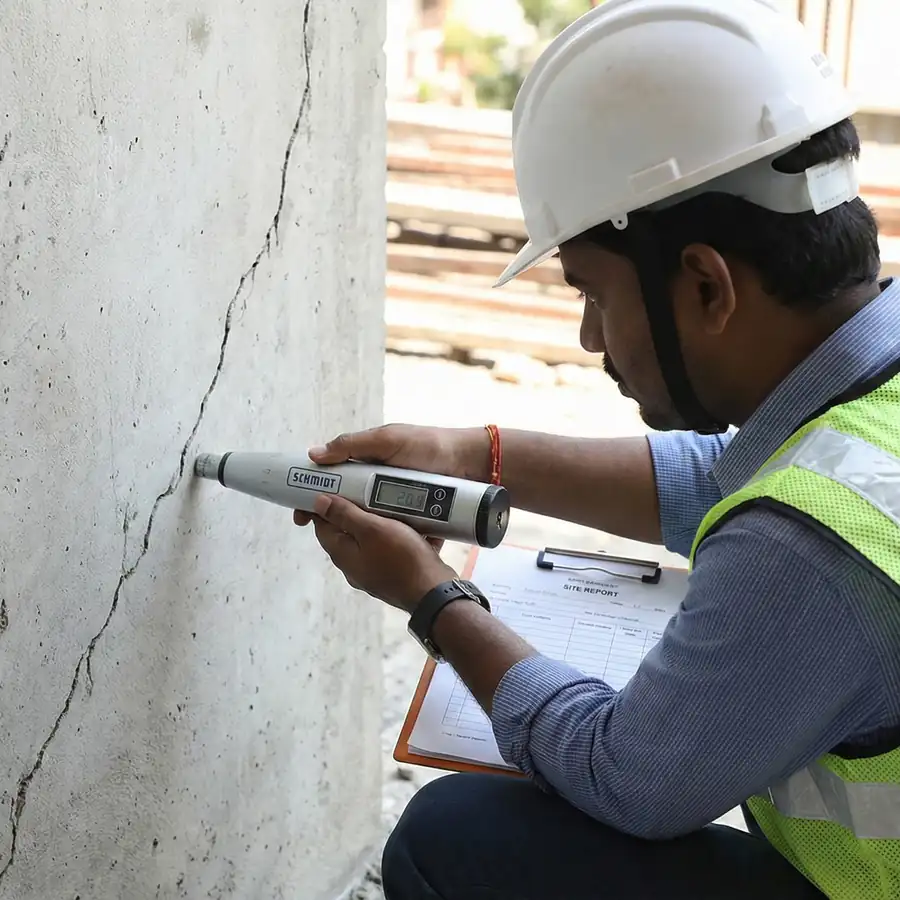
Structural Sense provides calibrated Non-Destructive Testing (NDT) services across Chennai. While visual mapping identifies surface distress, critical safety and asset decisions demand sub-surface certainty. We deploy digital Schmidt Rebound Hammers, Ultrasonic Pulse Velocity (UPV) scanners, and rebar locators to measure in-situ concrete strength without structural disruption.
Empirical in-situ strength verification backed by Registered Structural Engineer Seal
When to deploy forensic concrete analysis.
Post-Incident & Fire Pathology
Following a factory fire, chemical leakage, or severe vibration event, visual damage reveals only the surface. We deploy NDT acoustic sweeps to map hidden internal thermal spalling, deep micro-cracks, and residual steel strength.
Fire & Damage ForensicsReal Estate Acquisition Due Diligence
Before acquiring a 15+ year old industrial warehouse, IT park, or apartment building, investors require empirical clarity. Our NDT scan uncovers internal rebar corrosion and degraded concrete hidden beneath fresh cosmetic paint.
Pre-Purchase Asset AuditChange-of-Use & Vertical Expansion
Adding additional floors or installing heavy industrial vibrating machinery requires rigorous structural capacity recalculation. We verify exact in-situ column compressive strength (fck) and foundation reserve capacity.
Load Capacity VerificationConstruction Disputes & Cube Failure
When 28-day concrete cube compression test results fail project specifications, or contractor material quality is contested, we act as an independent authority performing non-invasive in-situ cross-verification.
Independent Third-Party AuditSub-surface verification. Precision tools.
We utilize internationally calibrated NDT equipment to extract precise mathematical data from your building without destructive cutting or operational downtime.
Ultrasonic Pulse Velocity (UPV)
Shooting ultrasonic pulses through concrete members to measure transit time. Detects internal voids, honeycombing, delamination, and crack depths invisible to the naked eye.
Digital Schmidt Rebound Hammer
Measures surface hardness and rebound numbers to estimate in-situ compressive strength across columns, beams, and slabs quickly with zero structural damage.
Rebar Locator & Cover Meter
Electromagnetic radar scanning to map concealed reinforcement bar diameter, grid spacing, and concrete cover thickness for accurate structural load recalculation.
Half-Cell Potentiometer
Measures localized electrochemical voltage potential to map active corrosion probability in steel reinforcement before visible rust staining or concrete spalling occurs.
Diamond Core Extraction & Crushing
When statutory disputes or critical calibration demand physical laboratory testing, surgical diamond core specimens are extracted and tested for true compressive strength.
Carbonation & Chemical Depth
Phenolphthalein chemical indicator testing on freshly exposed concrete to determine pH reduction and calculate the depth of carbonation front approaching embedded rebar.
The Diagnostic Dossier. Uncompromising empirical data.
We deliver a comprehensive, structured diagnostic ledger that provides the exact sub-surface metrics required by your structural engineering team to perform accurate load capacity, stability certification, or retrofitting design.
Raw Metric Cataloging & Calibration
Meticulous logging of all raw field data extracted directly from calibrated instruments, including exact UPV transit times, Half-Cell voltage gradients, and Rebound Hammer impact indices for total scientific transparency.
Structural Grid & Strength Contour Mapping
Raw figures are plotted directly onto CAD framing grid plans. This visualizes exactly where members possess adequate strength and highlights localized low-strength or high-corrosion zones.
The Certified Forensic NDT Dossier
A legally defensible engineering document signed and sealed by our Registered Structural Engineer, complete with remediation recommendations, IS-code compliance evaluations, and retrofitting blueprints.
Forensic accuracy. Massive financial savings.
NDT is not an expense—it is a financial shield. See how our structural pathology reports provided the exact data required to prevent unnecessary demolition and protect asset value.
Industrial Warehouse Chemical Fire Assessment
Commercial Tower Pre-Purchase Due Diligence
Related NDT Guides & Technical Insights
Structural Stability Certificate in Chennai: Complete Engineering & Legal Guide
Comprehensive breakdown of Form A/B/C, Factories Act mandates, inspection procedures, and CMDA compliance.
Adding a Floor to an Existing House in Chennai: Structural Assessment Guide
How to evaluate foundation load capacity, column strength, and soil stability before vertical construction.
House Construction & Structural Detailing Costs in Chennai (2026 Guide)
Comprehensive breakdown of steel, cement, and structural engineering optimization to reduce building costs.
NDT Testing & Diagnostic FAQ
If the NDT report reveals low concrete strength, can you execute the repairs?
Yes. Structural Sense provides single-point end-to-end accountability. If your concrete fails compressive strength benchmarks, our specialized Structural Strengthening division engineers and executes the required retrofitting (such as CFRP wrapping, micro-concrete column jacketing, or crack injection grouting).
How is the cost of Non-Destructive Testing calculated in Chennai?
NDT testing charges depend on the asset built-up area, structural member count, test locations, and the specific diagnostic suite required (e.g. Rebound Hammer vs UPV vs Core Extraction). We provide a transparent scope-of-work proposal tailored to your engineering objectives.
Will NDT testing cause disruption to our factory or building operations?
No. Non-Destructive Testing is completely non-invasive and produces minimal noise. Our engineers conduct diagnostic sweeps smoothly alongside active manufacturing or office operations with zero production downtime.
Is an NDT structural audit mandatory for older buildings in Tamil Nadu?
Yes. For industrial factories, commercial complexes, and public buildings older than 15–20 years, statutory bodies (Factories Inspectorate, CMDA, GCC) and insurers mandate periodic structural soundness certifications backed by empirical NDT test data.
How long does it take to receive the final NDT Diagnostic Dossier?
Physical on-site diagnostic sweeps are typically completed within 1 to 2 days. The comprehensive, registered structural engineer sealed NDT report is delivered within 48 to 72 hours (or 5–7 business days if laboratory core crushing is included).
Do not guess. Know your building's true strength.
Whether facing an impending statutory audit, planning a vertical expansion, or resolving a construction cube dispute, you need empirical certainty. Connect with our registered structural engineering team today to deploy an immediate NDT diagnostic sweep.
Beyond Diagnostics: Complete Structural Lifecycle
Structural Audits & Diagnostics
Technical identification of building distress, wall cracks, and foundation settlement with data-backed remediation roadmaps.
Explore ServiceStructural Strengthening & Retrofit
CFRP carbon fiber wrapping, column jacketing, and micro-concrete section enlargement to upgrade building capacity.
Explore ServiceStability Certification (Form A/B/C)
Statutory structural safety certificates for factories, schools, hospitals, and commercial buildings under Public Buildings & Factories Acts.
Explore Service