Can Your Old House Support Another Floor? The Vertical Expansion Guide
The Physics of Vertical Expansion
Local building masons often claim, "The columns look thick enough, it will be fine." This is an extremely dangerous gamble. Adding a standard 1,000 sq.ft floor forces existing ground-floor columns and footings to carry an additional 60 to 80 tonnes of dead weight. If the original foundation was only designed for G+0 or G+1, the excessive axial stress causes sudden diagonal shear cracking, rebar yielding, and differential foundation settlement.
CMDA & GCC Approval Rules for Adding a Floor
Beyond physics, vertical expansion in Chennai is strictly governed by municipal zoning laws. Any addition or alteration to an existing building within the Chennai Metropolitan Area requires prior written planning permission from the Greater Chennai Corporation (GCC) or the CMDA. Building without official sanction is illegal, exposing homeowners to heavy municipal penalties, mortgage loan rejections, and potential demolition notices.
Two critical regulatory checks dictate whether you can legally add a floor:
1. Floor Space Index (FSI): The total built-up area is capped by the FSI, which typically ranges from 1.5 to 2.0 for residential buildings in Chennai, determined by the width of your abutting road.
2. The 30-Year Rule: Under Tamil Nadu regulations, if your existing building is over 30 years old, municipal authorities mandate a rigorous Structural Stability Certificate from a registered structural engineer to prove the aging building is safe for human habitation under the new load.
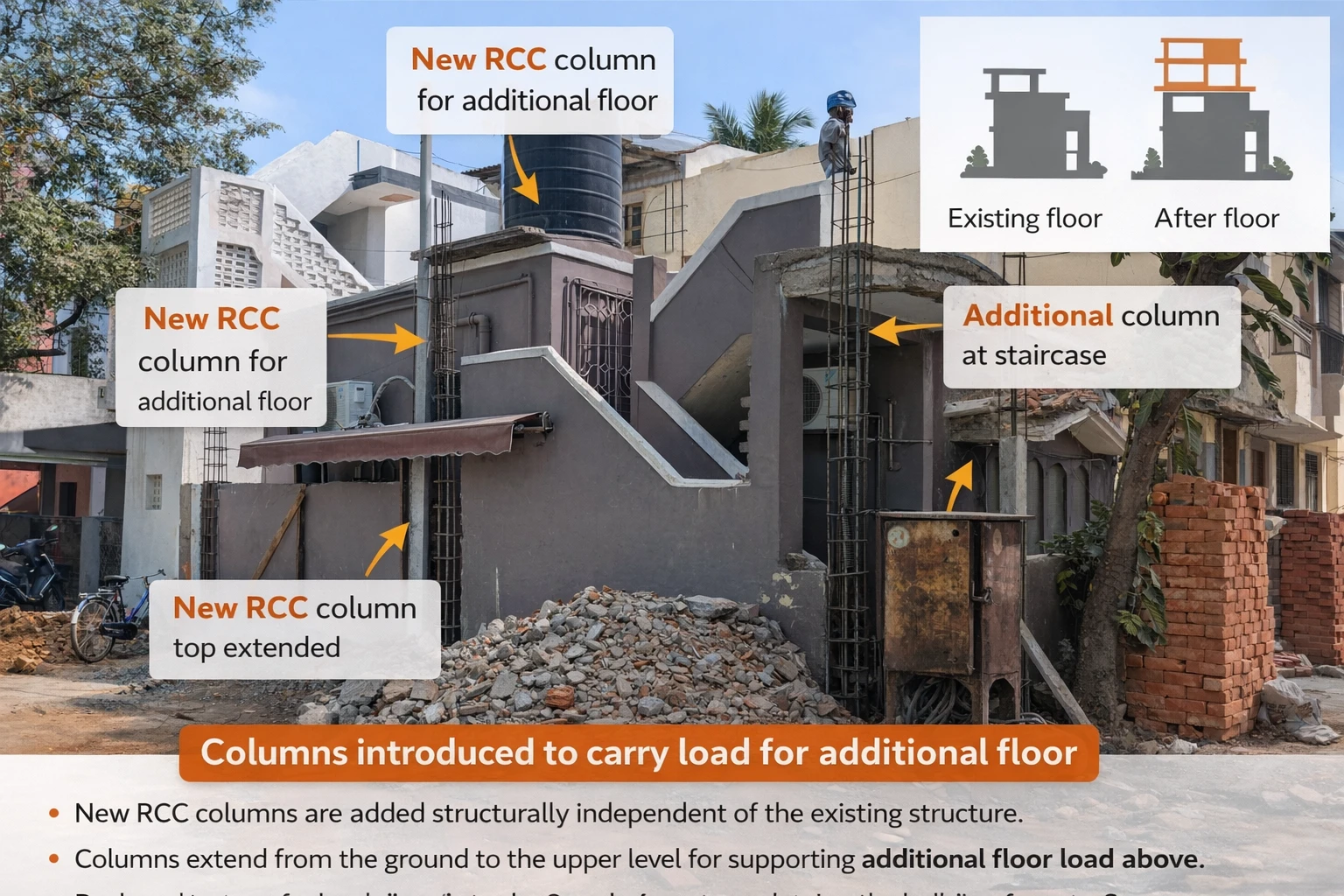
The Structural Load Verification Matrix
To guarantee the safety of your family and provide the engineering proof required for GCC plan approval, Structural Sense deploys a strict mathematical verification protocol:
| Structural Element | Engineering Diagnostic Tool | Diagnostic Verification Objective |
|---|---|---|
| Existing Columns | Rebound Hammer / Core Testing | Verifying if the old concrete still possesses required compressive strength (e.g., M20/M25) to carry the new vertical floor without crushing. |
| Concealed Rebar | Cover Meter / Rebar Profiling | Checking the exact diameter and cover of existing concealed steel to ensure it can withstand increased bending moments and tensile forces. |
| Foundation / Footing | Load-Path Calculation (STAAD.Pro) | Calculating if the existing soil's Safe Bearing Capacity (SBC) and footing dimensions will settle or sink under the added dead weight. |
The 2026 Assessment Cost Matrix
Do not risk a ₹30 Lakh+ construction investment without spending a fraction of that on structural validation. We provide the mandatory engineering documentation required for your GCC building plan approval:
| Assessment Tier | Engineering Scope & Deliverable | Professional Fee |
|---|---|---|
| Professional Site Inspection | Visual audit, load-path mapping, crack grading, and blueprint review to determine base vertical feasibility. | ₹5,900 (Incl. GST) |
| NDT Concrete Diagnostics | Deployment of UPV or Rebound Hammer to mathematically verify the existing concrete's internal strength. | Quoted Post-Inspection |
| New Floor Structural Design | Full IS-Code compliant structural drawings for the new roof slab, beams, and columns for GCC/CMDA submission. | Based on Built-Up Area |
Value Engineering: What if the Old House is Weak?
If our NDT testing reveals that ground-floor columns are marginally weak, you do not have to abandon your expansion plans. As a CMDA Registered Structural Engineer, I utilize modern value engineering to safely bypass these limitations:
Lightweight Dead-Load Design (AAC Blocks)
Instead of heavy traditional clay bricks, we engineer the new floor using AAC (Autoclaved Aerated Concrete) blocks. This instantly strips up to 30% of the dead weight off the ground-floor columns, drastically reducing the risk of foundation failure.
Steel Roof Alternatives
If the foundation cannot support a heavy 6-inch RCC concrete slab, we can engineer an insulated steel-framed roofing system, drastically lowering the load while maintaining thermal insulation and structural longevity.
Column Jacketing & CFRP Retrofitting
If columns are critically distressed, we design a Carbon Fiber Wrap (CFRP) or micro-concrete column jacket to upgrade compressive and lateral load capacity before constructing the new floor.
Professional Structural Stability Audit
Before hiring a contractor to add a floor, book a ₹5,900 Site Inspection Audit. Let us mathematically verify your building's safety and provide the mandatory stability certificates for GCC approval.
Frequently Asked Questions on Adding a Floor
Explore Related Forensic Case Studies & Engineering Guides
Building Vibration & Severe Beam Deflection Fix
Forensic NDT investigation and CFRP composite retrofitting specifications for a severe floor vibration issue.
Concrete Falling from Ceiling & Rusted Steel Repair
Forensic remediation of spalling ceilings and corroded reinforcement in a 35-year-old coastal apartment.
Compound Wall Crack Repair & Soil Settlement
Geotechnical soil investigation and underpinning specifications for a settling compound wall on clayey subsoil.
House Construction Cost in Chennai 2026 (Per Sq Ft)
Live predictive cost analytics calculator and material breakdown for TMT steel, concrete, and finishes.
Dangerous Column Cracks: Diagnostic & Repair Guide
Identify 45° shear, flexural, and spalling crack patterns with engineered micro-concrete jacketing steps.
Stability Certificate for Old Buildings (30-Year Rule)
Statutory audit rules, redevelopment laws under TN Apartment Ownership Act 2022, and Form B compliance.