Geotechnical Soil Testing
in Chennai.
Structural Sense provides expert geotechnical soil testing and subsurface investigation across Chennai. A multi-crore asset is only as secure as the earth beneath it. We extract deep-strata core samples, calculate Safe Bearing Capacity (SBC), and deliver foundation design directives that eliminate differential settlement and wasteful over-engineering.
Certified Geotechnical Dossier signed by Registered Structural Engineer for CMDA / DTCP Approvals
When to deploy geotechnical analysis.
High-Rise & Deep Foundations
Vertical expansion multiplies foundation pressure. We extract deep-strata core samples to map the exact depth of hard rock refusal, determining whether costly pile foundations are mandated or if optimized shallow raft footings suffice.
Foundation OptimizationIndustrial Heavy Machinery
Manufacturing plants subject earth to dynamic machine vibrations. We assess soil shear modulus, cohesion, and compressibility to design failure-proof machine footings that will not undergo differential settlement.
Dynamic Load BearingPre-Purchase Land Due Diligence
Never acquire commercial or residential acreage without knowing what lies beneath. Our rapid exploratory boreholes detect hidden loose fill, expansive black cotton clay, or shallow groundwater traps before finalizing transactions.
Land Acquisition AuditCoastal & Reclaimed Marshlands
Chennai's coastal corridors (OMR, ECR, Ennore) and reclaimed lakebeds are highly prone to soil liquefaction and sinking. We execute Standard Penetration Tests (SPT) to guarantee seismic safety in high-risk zones.
Liquefaction AssessmentDeep strata extraction. Zero guesswork.
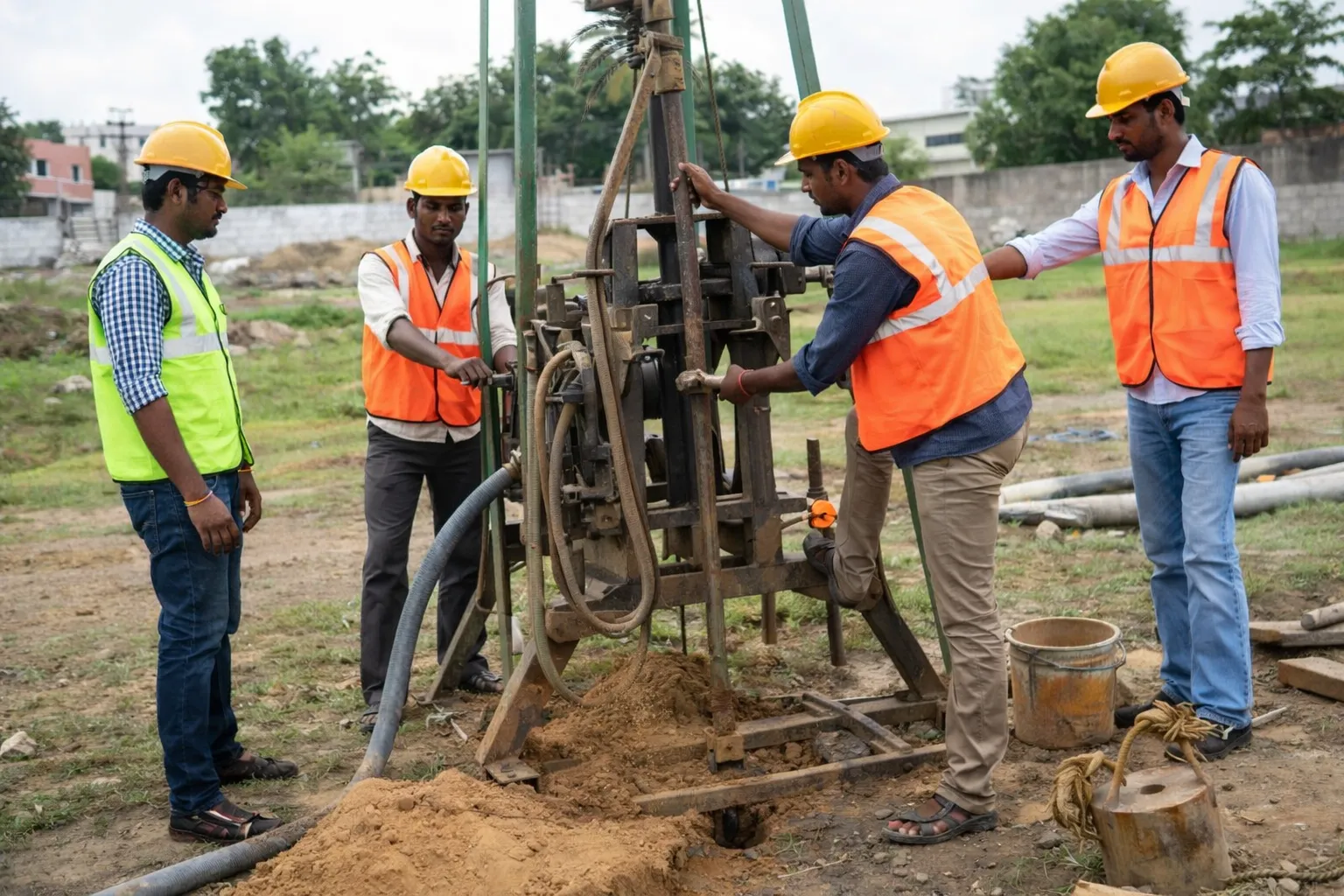
We deploy mechanized rotary drilling rigs and in-situ testing equipment to penetrate unpredictable terrain, retrieving empirical evidence to calculate your safe bearing capacity.
Hydraulic Rotary Drilling
Deploying mechanized rotary rigs to bore through loose fill, stiff clay, and weathered rock down to bedrock refusal, extracting undisturbed core samples for laboratory analysis.
Standard Penetration Test (SPT)
The global gold standard for geotechnical mapping. Controlled 63.5 kg drop-hammer impacts inside the borehole determine soil resistance (N-value) and density at 1.5m vertical intervals.
Plate Load Testing (PLT)
Directly applying immense hydraulic load on a circular steel plate on-site, simulating the actual stress your foundation will impose and measuring immediate settlement.
Geotechnical Laboratory Soil Testing
Extracted soil cores undergo Triaxial Shear, Consolidation, Direct Shear, Sieve Analysis, Atterberg Limits, and Chemical Sulphate testing conforming to IS 2720 standards.
The Geotechnical Dossier. Sub-strata certainty.
We do not just hand you raw bore logs and dirt samples. We deliver a comprehensive, structured geotechnical ledger that provides your structural engineering team with the exact Safe Bearing Capacity (SBC) and foundation directives required to engineer a failure-proof asset.
Borehole Stratigraphy & Log Profile
A comprehensive geological cross-section mapping every layer of earth encountered during drilling, including exact depths of soil transition, groundwater table levels, and corresponding SPT N-values.
Safe Bearing Capacity (SBC) & Settlement
We synthesize laboratory shear and consolidation metrics to compute net and gross Safe Bearing Capacity at various depths, projecting long-term settlement to prevent sinking over the 50+ year asset lifespan.
Foundation Design Directives
Actionable recommendations on optimal foundation type (Isolated Footings, Raft, or Deep Piles) and concrete chemical protection guidelines (sulphate/chloride resistant cement) to prevent subterranean foundation corrosion.
The catastrophic cost of assumption.
Soil testing is not a municipal formality; it is a massive financial shield. In Chennai's diverse terrain, skipping a geotechnical investigation frequently leads to severe structural disasters.
The Over-Engineering Trap
Differential Settlement
Uncompromising data. Transparent economics.
We reject hidden mobilization fees and vague estimates. Below is our definitive commercial ledger for geotechnical soil investigations in the Chennai metropolitan area.
Includes mechanized rotary borehole drilling, SPT N-value testing at 1.5m intervals, undisturbed core extraction, comprehensive laboratory soil testing, and the complete Geotechnical Dossier with SBC recommendations.
If hard rock refusal is not achieved at the baseline 10m mark, our rigs continue penetrating. Depth extensions are executed in controlled intervals until safe bearing strata is proven.
One-time site mobilization fee covering transport of heavy rotary drilling rigs and technical crew within Chennai city limits.
How many boreholes do you need?
Your borehole count is governed by plot footprint under IS 1892:2021 (Subsurface Investigation Code) to ensure structural compliance:
Related Geotechnical & Foundation Guides
Adding a Floor to an Existing House in Chennai: Soil & Foundation Assessment
How to evaluate foundation load capacity, soil stability, and column strength before vertical construction.
Structural Stability Certificate in Chennai: Complete Engineering & Legal Guide
Comprehensive breakdown of Form A/B/C, Factories Act mandates, inspection procedures, and CMDA compliance.
House Construction & Structural Detailing Costs in Chennai (2026 Guide)
Comprehensive breakdown of steel, cement, foundation optimization, and engineering costs.
Geotechnical & Soil Testing FAQ
Can I just use the soil report from the building next door?
Absolutely not. Soil stratigraphy is highly volatile. Pockets of soft clay, fluctuating groundwater levels, or a sudden drop in bedrock refusal depth often occur within a span of just 10 meters. Relying on adjacent plot data is a severe legal liability and the leading cause of unexpected foundation settlement.
My plot currently has an old house on it. Can you test before demolition?
Yes. If there is a minimum clearance area of 10x10 feet and a clear 1-meter pathway, we can deploy portable tripod rigs (caliper rigs) to execute the SPT drilling in the setbacks or driveway. This allows your architects to finalize foundation designs while you await demolition permits.
Our site is waterlogged. Can your drilling rigs still operate?
Yes. Many plots along the OMR and ECR coastal corridors suffer from high groundwater tables or monsoon waterlogging. We deploy heavy-duty steel casing pipes to prevent borehole collapse in marshy areas, ensuring accurate sub-strata core extraction.
Do we need to arrange 3-phase electricity or water for the drilling team?
Our mechanized rotary rigs run on diesel and are entirely self-sufficient regarding power. However, rotary drilling does require a water supply to flush the borehole during extraction. If your empty plot lacks a borewell or municipal connection, we can arrange water tankers at a nominal logistical cost.
Is a Geotechnical Soil Report mandatory for CMDA approval?
Yes. For multi-story residential apartments, commercial complexes, and industrial factories in Chennai, the CMDA, DTCP, and GCC strictly mandate a certified soil investigation report to approve structural drawings. Our Authorized Engineering team provides the legally compliant dossier for rapid clearance.
Do not guess. Engineer with empirical certainty.
Before pouring a single cubic meter of foundation concrete, secure the empirical geotechnical data that protects your multi-crore investment. Connect with our authorized geotechnical team today to schedule your soil investigation (starting from ₹13,000 / borehole).
From Soil to Sky: Full Structural Engineering Lifecycle
Structural Design & Engineering
IS-code compliant RCC & steel structural design, foundation detailing, and seismic load optimization.
Explore ServiceForensic NDT Concrete Testing
Non-destructive in-situ strength evaluation using Rebound Hammer and UPV ultrasonic testing without demolition.
Explore ServiceStability Certification (Form A/B/C)
Statutory structural safety certificates for factories, schools, hospitals, and commercial buildings under Public Buildings & Factories Acts.
Explore Service