Structural Stability Certificate for Old Buildings in Chennai — Complete Guide

Er. S. Pughalmathi, Structural Sense india Pivate Limited
Structural Consultant

Quick Summary

If your building is over 15 years old, do you really know its structural condition?

What is it?A structural stability certificate is a formal document issued by a CMDA-registered structural engineer after physically inspecting and testing a building, confirming its structural condition and safety.

Who typically needs it?Schools, colleges, hospitals, factories, hostels, and commercial buildings requiring government approvals or licences · Building owners involved in legal or regulatory proceedings · Anyone purchasing a high-value building and wanting to verify its structural health before committing to the transaction.

What does the process involve?Visual inspection + NDT Testing (Rebound Hammer, UPV, Half-Cell Potential) + structural analysis. If further investigation is needed, destructive testing such as core cut testing is carried out.

Outcome:If the building is structurally sound, a stability certificate is issued. If deficiencies are found, detailed recommendations for strengthening are provided — and the certificate is issued after the strengthening work is completed and verified.

Structural Stability Certificate for Old Buildings in Chennai — Complete Guide

By Er. S. Pughalmathi, Structural Engineer, Structural Sense India Pvt. Ltd. | Anna Nagar, Chennai

Understanding the structural health of an old building is one of the most important steps any building owner, buyer, or institution can take. Whether you are applying for a government approval, renewing a licence, purchasing a high-value property, or dealing with a legal requirement — a structural assessment gives you accurate, engineer-certified information about the condition of your building.

This guide explains what a structural stability certificate is, when it is needed, what the inspection and testing process involves, and what happens at the end — whether the building passes or requires strengthening.

Important: A building that looks fine from the outside may have significant internal deterioration. Rebar corrosion — the single biggest structural threat to old RCC buildings in Chennai — produces no visible surface signs until concrete begins to spall. By that point, structural capacity is already seriously reduced.

1. What Is a Structural Stability Certificate?

A structural stability certificate is a formal document issued by a licensed structural engineer confirming that a building has been physically inspected, tested where required, and is structurally safe for its intended use. It is based on a fresh, site-specific engineering assessment — not historical records or photographs.

The certificate must carry the engineer's name, qualification, CMDA registration number, seal, and original signature. Without these elements, it will not be accepted by licensing authorities, courts, or financial institutions.

It is fundamentally different from a completion certificate, which is issued by CMDA or the Corporation when a new building is constructed to its approved plan. A stability certificate is a live assessment of the current structural condition of an existing building.

2. When Is a Structural Stability Certificate Required?

A structural stability certificate is not universally mandatory for all buildings. It is specifically required in the following situations:

A. Government Approvals and Licences: Schools, colleges, coaching centres, hospitals, nursing homes, hotels, restaurants, hostels, factories, and warehouses require a structural stability certificate as part of their licensing process. In Tamil Nadu, this is a prerequisite under the Tamil Nadu Public Buildings (Licensing) Act for obtaining or renewing operational licences from the relevant authority.

B. Legal and Regulatory Proceedings When a building is the subject of a legal dispute, court proceedings, or a regulatory inquiry, an independent structural assessment and stability certificate from a CMDA-registered engineer is required as part of the documentary evidence.

C. Pre-Purchase Structural Health Check Before purchasing a high-value building — a large independent house, a commercial property, or an institutional building — a structural health assessment is strongly advisable. This gives the buyer a clear, engineer-certified picture of the building's condition before committing to the transaction. Hidden structural deficiencies not visible during a routine property visit can have significant financial consequences after purchase.

D. Floor Addition to an Existing Building Before adding a new floor, the structural health of the existing structure must be assessed. The engineer evaluates whether the existing foundation, columns, and slabs have adequate capacity to carry the additional load. This assessment is a prerequisite before any floor addition work begins.

E. After a Disaster or Significant Damage Event Following cyclones, floods, fires, or significant structural impact, a stability assessment is required before reoccupation of the building to confirm the structure remains safe.

3. Why Old Buildings Need a Thorough Structural Assessment

Concrete and steel reinforcement deteriorate over time through processes that are often invisible from the surface. For buildings that are 15 years or older, a visual inspection alone is insufficient:

  • Carbonation: CO₂ from the atmosphere reacts with calcium hydroxide in concrete, reducing its alkalinity. Once the carbonation front reaches the reinforcing steel, corrosion begins — even without any visible surface cracking.
  • Chloride ingress: Especially common near Chennai's coastline and in areas with saline groundwater. Chlorides penetrate concrete and attack the passive layer that protects rebar from corrosion.
  • Cumulative loading changes: Informal floor additions, heavy water tanks, and partition walls added over the years may have incrementally loaded the original structure beyond its design capacity.
  • Concrete creep and shrinkage: Long-term deformation under sustained load reduces structural stiffness over decades, sometimes visible as deflection in slabs and beams.

4. The Assessment Process — 4 Stages

For most buildings, the site work is completed in one day and the full report and certificate are ready within 5–7 working days.

Stage 1 → Document Review Stage 2 → Visual Survey Stage 3 → NDT Testing Stage 4 → Certificate or Strengthening Recommendations

Stage 1 — Document Review

  • Structural drawing of the building
  • Architectural or building plan
  • Previous inspection or structural reports (if any)
  • Details of any modifications, additions, or repairs carried out over the years

If structural drawings are unavailable — which is common for buildings constructed before 2000 — the engineer conducts a field-measured survey to document the existing structural system before proceeding with the assessment.

Stage 2 — Visual Structural Survey

A systematic element-by-element inspection of the entire building covering:

  • Crack pattern mapping on columns, beams, slabs, and walls
  • Identification of spalling, delamination, or exposed reinforcing steel
  • Assessment of visible deflection or distortion in structural members
  • Terrace drainage, slope, and waterproofing condition
  • Foundation exposure or surrounding ground condition where accessible
  • Feasibility assessment for NDT testing — identifying elements and locations suitable for testing based on access, surface condition, and structural significance

Stage 3 — Non-Destructive Testing (NDT)

NDT allows the engineer to quantify the internal condition of concrete without damaging the structure. For old buildings, this is the most critical stage of the assessment.

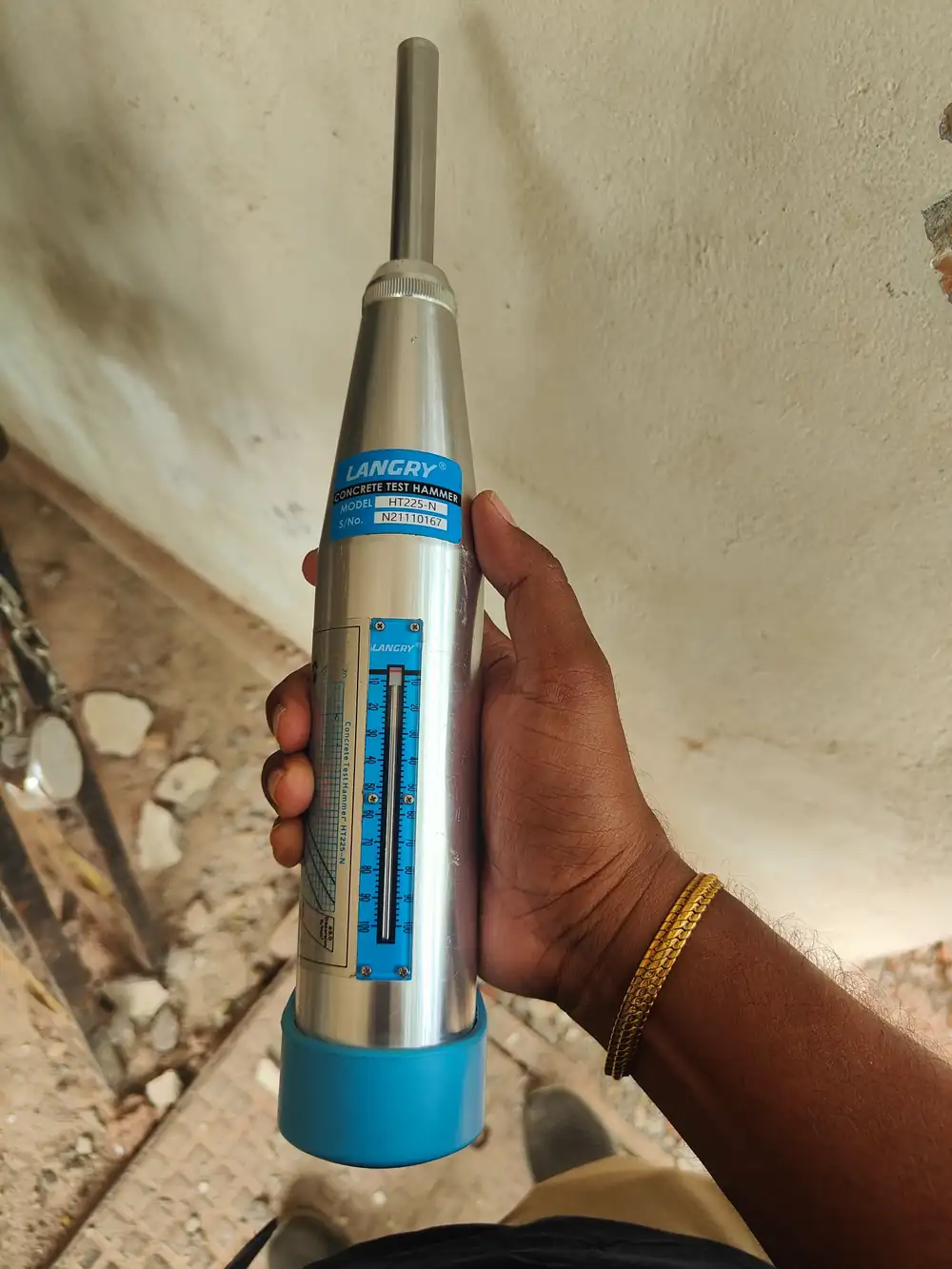
Rebound Hammer Test — measures surface hardness and estimates compressive strength (N/mm²). Confirms whether concrete has degraded below its original design strength.

Ultrasonic Pulse Velocity (UPV) Test — measures internal concrete homogeneity and crack depth. Detects hidden voids, cracks, and delamination not visible from the surface.

Half-Cell Potential Test — measures the probability of active rebar corrosion. Particularly important for buildings in coastal Chennai and structures built before 2000.

Carbonation Depth Test — measures how far CO₂ has penetrated toward the reinforcing steel. Predicts the remaining service life of the concrete cover.

Cover Meter / Rebar Locator — measures actual rebar cover thickness. Confirms whether the cover is adequate or whether reinforcement is already at risk.

When destructive testing is required: If NDT results indicate areas of concern that need further investigation, the engineer proceeds with Core Cut Testing. A concrete core is drilled and extracted from the structural element and laboratory-tested to determine the actual compressive strength of the concrete. Core cut testing provides definitive data where NDT provides an indication.

Stage 4 — Certificate or Strengthening Recommendations

There are two possible outcomes:

If the building is structurally sound — the structural engineer issues the Structural Stability Certificate. This is a signed, sealed formal document confirming the building is safe for its intended occupancy and use.

If structural deficiencies are found — the engineer provides a detailed report specifying exactly what strengthening or repair work is required, such as column jacketing, beam strengthening, slab repair, or foundation remediation. The certificate is not issued at this stage. Once the specified work is completed and verified by the structural engineer on site, the Structural Stability Certificate is then issued.

After the certificate is issued: No structural alteration to the building is permitted without the prior knowledge and approval of the structural engineer. Any alteration carried out without the engineer's involvement will automatically invalidate the certificate.

5. Structural Stability Certificate Forms — Form A, B, C and E

Form A — Application by the Building Owner. Submitted by the owner to initiate the certification process.

Form B — Technical Statement by the Engineer. The engineer's formal declaration covering load assessment, building age, soil details, and structural condition.

Form C — Certificate of Structural Soundness. The core document — the actual stability certificate. This is what licensing authorities, courts, and financial institutions require.

Form E — Application for Renewal of Certificate. Used when an existing Form C certificate expires and needs to be renewed after re-inspection.

When a licensing authority, court, or institution asks for a structural stability certificate, they are asking for Form C. Forms A and B are the supporting documents that accompany it.

6. What Must the Certificate Contain?

A valid, authority-accepted structural stability certificate must include all of the following. If any element is missing, the submitting authority will reject it:

  • Engineer's letterhead with name, qualification (B.E./M.E. Civil or Structural Engineering), and firm name
  • CMDA registration number clearly visible on the letterhead
  • Property address, owner name, and survey or door number
  • Date of inspection and methodology used
  • Summary of NDT test results with actual readings for buildings over 15 years
  • Core cut test results where destructive testing was carried out
  • Structural condition assessment: Good / Satisfactory / Requires Strengthening
  • Purpose of the certificate: licensing / legal / pre-purchase / floor addition
  • Validity period of the certificate
  • Engineer's original signature and official seal

Certificates issued without a site inspection, without NDT testing data, or by an unregistered consultant will not be accepted by Tamil Nadu licensing authorities, courts, or financial institutions.

7. Documents Required from the Building Owner

Structural drawing of the building — preferred. If unavailable, the engineer conducts a field-measured survey.

Building or floor plan — preferred. Helps the engineer understand the structural layout and identify any deviations.

Completion certificate from CMDA or Corporation — preferred. Confirms the original legal status of the construction.

Previous structural inspection report — if available. Provides a baseline for comparison with current condition.

Details of any modifications or additions — must be disclosed. Undisclosed alterations affect the accuracy of the structural assessment.

If structural drawings are not available, that is not a barrier. A field-measured survey is standard practice for buildings constructed before 2000 in Chennai.

8. Validity of the Certificate

Good condition — concrete strength adequate, no active corrosion detected: 3 years validity.

Satisfactory condition — minor issues noted, structure safe for current use: 1 to 2 years validity.

Requires strengthening — significant deficiencies found: certificate is issued only after the strengthening work is completed and verified.

Once issued, no structural alteration is permitted without the prior knowledge and approval of the structural engineer. Any unauthorised alteration will render the certificate invalid.

9. Why a CMDA-Registered Structural Engineer

CMDA registration confirms the engineer is recognised by Chennai's development authority and their certificates are accepted for official submissions to government bodies.

Structural engineering qualification (B.E./M.E.) confirms the technical competency to assess reinforced concrete structures. Not all civil engineers hold this specialisation.

Calibrated NDT equipment and trained operators are required for test results to be technically valid and legally defensible.

Professional liability means the engineer is legally accountable for the accuracy of their assessment and certificate.

Structural Sense India Private Limited | CMDA Reg: RE203082022 | Director: Er. S. Pughalmathi | Anna Nagar, Chennai | structuralsense.in

FAQ — Structural Stability Certificate for Old Buildings in Chennai

1. Is a structural stability certificate required for all buildings?No. It is specifically required when a building is subject to a government licensing or approval process — such as schools, colleges, hospitals, factories, hostels, and commercial establishments. It is also required in legal proceedings and is strongly advisable before purchasing a high-value building. For general residential occupancy without any approval requirement, it is not universally mandatory — though a structural health assessment is always a prudent step for buildings over 15 years.

2. What is the difference between a structural health assessment and a stability certificate?A structural health assessment is the engineering process — inspection, NDT testing, analysis, and findings. A structural stability certificate is the formal document issued at the end of that process, once the engineer confirms the building meets the required standard. The assessment is what the engineer carries out; the certificate is what they issue based on the findings.

3. What happens if the building does not pass the assessment?The engineer will not issue the certificate at that stage. A detailed report is provided specifying exactly what strengthening or repair work is required. Once that work is completed and verified by the structural engineer on site, the certificate is then issued.

4. Can I make changes to my building after the certificate is issued?No structural alteration may be made without the prior knowledge and approval of the structural engineer who issued the certificate. Any alteration carried out without this involvement will automatically invalidate the certificate.

5. Is NDT testing always required?For buildings over 15 years, or those showing any signs of deterioration, NDT testing is necessary for the certificate to carry technical and legal credibility. Where NDT results are inconclusive or indicate a concern, core cut testing is carried out to provide definitive data.

6. What is core cut testing and when is it used?Core cut testing is a form of destructive testing where a cylindrical concrete sample is drilled from a structural element and laboratory-tested to determine the actual compressive strength of the concrete. It is used when NDT results indicate a concern that requires confirmation, or when precise strength data is needed for structural analysis.

7. Does the structural drawing need to be the original CMDA-approved drawing?The structural drawing of the building is the preferred starting point for any assessment. If it is not available, the engineer conducts a field-measured survey to document the existing structure. This is standard practice for buildings constructed before 2000 and is not a barrier to proceeding with the assessment.

Connect
with us!

Cost-effective, durable solutions with efficient streamlined designs.
Start the Project
Thank you! Your submission has been received!
Oops! Something went wrong while submitting the form.
Engineering Guides & Structural Resources
Get in touch
February 14, 2026
Structural Stability Certificate in Chennai: The Complete Guide (2026)
Need a Structural Stability Certificate in Chennai for a School, Factory, or House? Learn about Form A, B, C, E, costs, and hiring a Registered Panel Engineer.
Read Now
February 7, 2026
Adding a Floor to an Existing House: Structural Inspection and Feasibility Check
Before adding floors to an existing building in Chennai, check your foundation. Discover the essential load analysis and structural steps required for adding another floor to your house
Read Now