NDT Concrete Testing: The IS Code Guide
X-Ray Vision for Your Concrete Structures
Whether you are purchasing a 20-year-old property, planning a vertical floor addition, or responding to GCC municipal stability notices, visual observation alone cannot verify internal concrete health. The concrete may appear pristine on the outside, but internal rebar may be compromised by coastal carbonation, or the core may conceal honeycomb voids and micro-fractures.
Non-Destructive Testing (NDT), strictly governed by Indian Standard IS 13311, allows our CMDA Registered Structural Engineers to forensically scan the internal geometry of your RCC framework. By extracting this empirical data, we provide a definitive, legally sound assessment of your building's structural safety.
NDT IS Code Cost & Sampling Estimator
Certified NDT testing requires precision-calibrated digital equipment, senior diagnostic engineers, and strict grid-based sampling. Use this interactive dashboard to calculate your building's required sample size and estimated 2026 testing fee in Chennai:
Forensic Diagnostic Estimator
Live 2026 Metrics based on IS 13311Engineering Prerequisite
Testing random columns produces unscientific data. A mandatory ₹5,900 Site Inspection Audit must be completed first to map load paths and formulate exact testing grid coordinates.
The Three Core NDT Methodologies
Depending on initial visual audit findings, our engineers deploy acoustic, mechanical, and electro-chemical diagnostic technologies:
Rebound Hammer Test (IS 13311 Part 2)
Primary Application: Surface Hardness & Compressive Strength. A calibrated spring-loaded mass impacts the concrete surface. By recording the rebound number and comparing it against calibrated compressive curves, we accurately evaluate whether columns hold the required M20 or M25 characteristic strength.
Ultrasonic Pulse Velocity / UPV (IS 13311 Part 1)
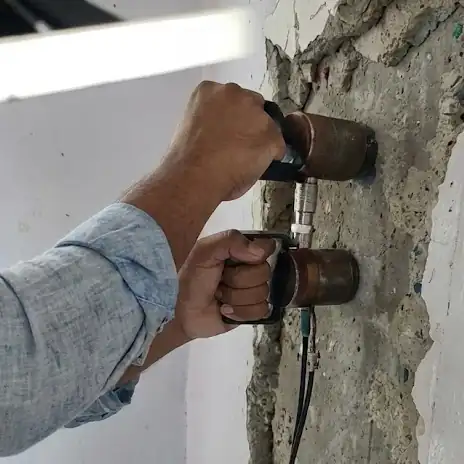
Primary Application: Internal Voids, Honeycombing & Cracks. Acoustic transducers are placed on opposite column faces to transmit high-frequency ultrasonic waves. Sound travels rapidly through dense concrete (>4.0 km/s). If wave transit time slows, it indicates internal voids, honeycombing, or hidden micro-fractures.
Half-Cell Potential Corrosion Profiling (ASTM C876)
Primary Application: Active Rebar Corrosion Detection. In coastal Chennai, airborne chlorides accelerate concrete carbonation. When embedded steel rebar oxidizes, it produces a measurable electro-chemical potential. By placing a copper-copper sulfate reference electrode on the grid, we map active corrosion zones years before external spalling occurs.
UPV Concrete Quality Grading Standards (IS 13311)
| Pulse Velocity (Cross Probing) | Concrete Quality Grading | Structural Action Recommended |
|---|---|---|
| Above 4.5 km/sec | Excellent | Structure is sound; proceed with standard maintenance. |
| 3.5 to 4.5 km/sec | Good | Acceptable load capacity; seal minor surface micro-pores. |
| 3.0 to 3.5 km/sec | Medium / Doubtful | Localized honeycombing; low-viscosity epoxy pressure grouting required. |
| Below 3.0 km/sec | Poor / Critical | Core distress; immediate column jacketing or CFRP retrofitting required. |
The Order of Operations for Certified Safety
To ensure strict ISO 9001:2015 engineering compliance and municipal approval, the diagnostic process follows a strict sequence:
1. Phase One: The Visual Audit
Book a ₹5,900 Site Inspection. Our CMDA registered engineers will physically map your building's load path, identify structural stress points, and formulate a targeted, code-compliant NDT testing grid.
2. Phase Two: Retrofitting Solutions
If NDT mathematical results reveal critical weakness, engage our specialized execution team to perform micro-concreting, CFRP wrapping, and permanent structural retrofitting.
Frequently Asked Questions on NDT Concrete Testing
Explore Related Forensic Case Studies & Engineering Guides
Apartment Building Structural Audit & NDT Testing
Forensic core strength testing, UPV scanning, and structural stability certification for a multi-storey community.
Concrete Falling & Rebar Corrosion Forensic Audit
Half-cell potential corrosion mapping and polymer-modified mortar repair specifications for coastal spalling.
Concrete Spalling & Beam-Column Repair (35-Yr Old Building)
Forensic NDT audit of column cover loss and junction shear cracks in a 35-year-old apartment complex.
Dangerous Column Cracks: Diagnostic & Repair Guide
Identify 45° shear, flexural, and spalling crack patterns with engineered micro-concrete jacketing steps.
Structural Stability Certificate in Chennai: Complete Guide
Form 1A-1E legal guidelines, GCC municipal notices, and public building certification rules.
Can Your Old House Support Another Floor?
Evaluate 60-80 tonne vertical dead loads, GCC planning approvals, and NDT column compressive strength.