Structural Inspection Case StudyLocation: Madhanakuppam, Chennai
House Soil Settlement and Water Seepage in Madhanakuppam, Chennai
Building: Ground-floor residential house, about 14 years oldScope: Visual condition assessment, inside and outsideLead engineer: Er. S. Pughalmathi, M.Tech
A plain-language account of a house inspection in Madhanakuppam, where water from three sources had settled the soil under the floor and was damaging walls and a column.
Key facts
Building
Ground-floor residential house, about 14 years old, in Madhanakuppam, Chennai
Inspected
10 November 2026 (report dated 13 November 2026)
Scope
Visual condition assessment of the exterior and interior. No instrument tests.
Main finding
Water seeping from the setback area, a leaking septic pit and toilet floor water, linked to settled soil under the floor, damp walls and a cracked column.
Recommended first step
Stop the water at its source, then repair the cracks, walls and column.
The Discovery
The owner of a ground-floor house in Madhanakuppam, Chennai, asked us for a visual condition assessment. The house is about 14 years old. Its walls were damp in several rooms, cracks had appeared inside and outside, and the floor in one part felt uneven underfoot.
On 10 November 2026 we walked the house from outside to inside. We looked at the front and back gates, the setback area around the building, the septic pit, the outer walls, the terrace, and every room including the kitchen, two bedrooms and the toilet. We recorded what we saw and noted the likely cause beside each observation. The causes were visible on site, so no instrument testing was needed for this assessment.
The report holds 12 numbered observations. Each is marked Minor, Moderate or Severe, and each carries a priority label: Recommended for Periodic Monitoring, Recommended for Early Rectification, or Immediate Attention Required. One observation was rated Severe, ten Moderate and one Minor. Four carry the Immediate Attention Required label, and they all point to the same thing: water.
Look at what the water is doing underground. A damp wall is often the last place the problem shows up.
Forensic Pathology
"Forensic pathology" simply means tracing a defect back to its cause, as a doctor looks for the illness behind a symptom. The symptoms in this house were spread across walls, floors, the terrace and a column. The causes were fewer.
Three sources of water
The setback area. This is the open strip of land between the house and its boundary. Gaps and cracks there let water seep in along the building edge. The report names this seepage as the root cause of the soil settlement, and it was the one Severe observation.
The septic pit. A sewage water leak was recorded, so the ground around it was being wetted again and again.
The toilet floor. Floor water was passing down into the underlying soil.
What the water had started to do
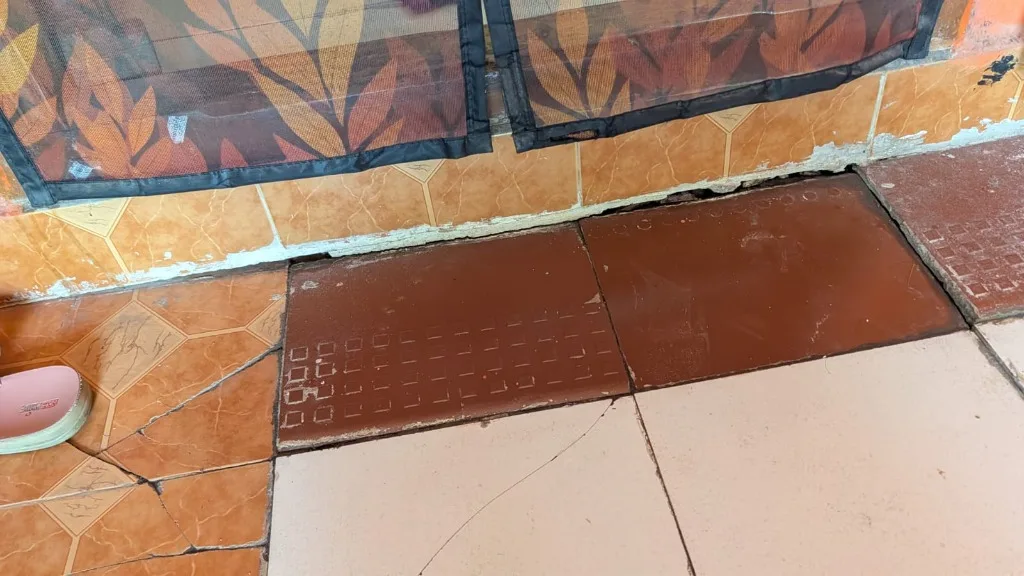
A house floor often rests on a layer of filling soil. When water keeps reaching that soil, it can settle and sink. In this house the flooring had turned undulating where the filling soil beneath had settled. The report also notes diagonal cracks on an exterior wall, possibly due to soil settlement. We did not treat these as an emergency, and we asked for them to be observed over time. Watching a crack for change tells an engineer whether the movement is still active.
Figure 1: Gaps and water stagnation in the setback area, where moisture penetrated along the building foundation edge.Figure 2: Depressed floor tiles and sunken threshold where subsoil filling had settled beneath.
The terrace, the column and the walls
Water from above was a second problem. Moisture from the terrace caused a crack and a bulge in the south-west column at terrace level. Concrete protects the steel bars inside it. When water keeps reaching those bars they rust, and rust takes up more space than steel, so it pushes the concrete outward and causes bulging and cracking. This is why the column was given the Immediate Attention Required label, as it is a load-carrying member.
The same terrace leakage showed up as minor cracks across the ceilings and as seepage in the bedrooms. In the kitchen, dampness was coming from the external sunshade. In the living room, one wall was cracked and bulging because of the rebar used in an earlier crack-stitching repair, and a second part of the wall was damp near the kitchen from seepage at the countertop and wall joints. A repair done without removing the moisture source can leave a new problem behind.
The front and back gates showed cracks around their support clamps, caused by moisture and corrosion of the clamps.
Figure 3: Diagonal fracture in gate support pillar triggered by moisture corrosion of the iron clamp.Figure 4: Blistering paint and dampness on kitchen wall from exterior sunshade moisture penetration.
What We Found, Area by Area
The table lists the main findings with the priority labels as they appear in the report.
Area
What we saw
Priority label
Setback area
Water seeping in along the building edge; the report's root cause of soil settlement
Immediate Attention Required
Septic pit
Sewage water leak
Immediate Attention Required
Toilet floor
Floor water going down into the soil beneath
Immediate Attention Required
South-west column
Crack and bulge at terrace level from terrace moisture
Immediate Attention Required
Flooring
Undulation from settled filling soil
Early Rectification
Terrace, sunshade and ceilings
Leakage into rooms below, minor ceiling cracks
Early Rectification
Living room, kitchen, bedrooms
Damp, bulging or seeping walls
Early Rectification
Gate clamps
Corroded clamps with cracks around them
Early Rectification
Diagonal wall cracks
Possibly due to soil settlement; to be observed
Periodic Monitoring
Code-Compliant Remediation Sequence
The order of work matters. Repairing walls and floors before the water is stopped means the same damage returns. Our report recommends this sequence.
01
Stop the water at its source
Seal the gaps and cracks around the setback area and give it a proper slope and drainage. Repair the septic pit and its pipe connections, seal them, and have the sewage water disposed of periodically. Waterproof the toilet floor and check the plumbing lines for leaks.
02
Waterproof the terrace and sunshade
Repair the terrace cracks and waterproof the floor to stop leakage into the rooms below. Fill cracks and waterproof the top surface of the sunshade over the kitchen.
03
Repair the south-west column
Remove the loose concrete at the cracked and bulged portion, apply primer on the exposed reinforcement, and carry out concrete strengthening.
04
Treat the gate clamps
Clean the corroded clamps, apply anti-corrosion primer, repair the cracks around them and seal the clamp fixing.
05
Repair the walls
Cut cracks into a V-groove and fill them with non-shrink grout, then apply a waterproof coating over the external walls. In the living room, remove the loose plaster, prime the exposed rebar and repack the area.
06
Watch the diagonal and minor cracks
Observe the diagonal cracks periodically for any change. Fill the minor cracks with crack grout after V-grooving, and keep monitoring them.
Preventive Pathology
Repairs fix today's damage. Regular care keeps it from coming back.
Periodic inspection. Have a structural engineer look over the house at planned intervals, including the setback area, terrace, external walls and any cracks being monitored, and keep each report on file.
Regular maintenance. Keep the setback drainage working, check plumbing lines and the septic pit for leaks, and re-coat terrace waterproofing and external wall protection on schedule.
Monitor cracks. Diagonal and minor cracks can be watched over time. A crack that grows or changes should be shown to an engineer.
Planning another floor? Get a structural assessment first. Existing settlement and water problems should be repaired, and the foundation and soil checked, before any new load is added.
This house shows moisture-related deterioration. The root cause is water seeping from the setback area, which led to soil settlement under the floor, along with leakage from the terrace, the toilet floor and the septic pit. These need rectification at the earliest. The diagonal cracks and minor cracks can be monitored periodically. The long-term answer is periodic inspection and regular maintenance of the setback drainage, plumbing lines, septic pit, terrace and external walls, so that any leakage or dampness is found and corrected promptly.
The inspection report
A visual inspection of a 14-year-old ground-floor house in Madhanakuppam, Chennai, recorded 12 observations. Water seeping from the setback area, a leaking septic pit and toilet floor water had settled the soil under the floor. The report also covers terrace leakage, damp walls and a cracked column, and sets out 11 repairs, urgent ones first. No instrument tests were needed.
Page 2: setback, septic pit and wallsPage 3: column and flooringPage 4: recommendationsPage 5: conclusion
Client details have been removed from the report. Tap a page to enlarge it.
Redacted and watermarked. Includes 12 observations, site photos and recommendations.
Frequently Asked Questions
Why does a floor sink or become uneven in a ground-floor house?
When water keeps seeping into the soil filled beneath a floor, the soil can settle and the flooring above it can turn undulating. In this house the water came from the setback area, a leaking septic pit and the toilet floor. An engineer needs to trace which source is active before any floor repair is planned.
Can a leaking septic pit affect a building?
A leaking pit keeps wetting the ground around it. In this case the sewage leak was one of three water sources linked to the settled soil, and it was marked Immediate Attention Required. Repairing and sealing the pit and its pipe connections, and having the sewage disposed of periodically, was part of the recommended work.
Can I add another floor to an older ground-floor house?
Not without a structural study first. An extra floor adds load, so an engineer needs to check the existing foundation, the soil condition and any cracks or settlement, and existing water problems must be repaired before any new load is added. The answer differs for every house, which is why an assessment of your own building comes first.