Structural Inspection Case StudyLocation: Velachery, Chennai
Apartment Dampness and Concrete Spalling in Velachery, Chennai
Building: B+G+9 apartment, about 20 years oldScope: Visual condition assessment of 40 flats and common areasLead engineer: Er. S. Pughalmathi, M.Tech
A plain-language account of a structural inspection in Velachery, where leaking pipes and damp walls on every floor were slowly damaging the concrete.
Key facts
Building
B+G+9 RCC apartment building, about 20 years old, in Velachery, Chennai
Inspected
26 and 27 October 2026 (report dated 30 October 2026)
Scope
Visual condition assessment of 40 flats and common areas, with hollow-sound checks. No instrument tests.
Main finding
Water from corroded GI pipes, plumbing shafts and unsealed wet areas, leading to dampness, concrete spalling and cracked columns in places.
Recommended first step
Stop the water at its source, then waterproof and repair the concrete.
The Discovery
The residents' association asked us for a condition assessment of their apartment building in Velachery, Chennai. The building has a basement, a ground floor and nine upper floors on an RCC (reinforced cement concrete) frame, with a lift core, service shafts and basement walls. It is about 20 years old, and its exterior was last painted roughly ten years ago.
On 26 and 27 October 2026 we walked the building from outside to inside: all four exterior walls, the common passages, the basement rooms, the ground-floor lobby, shops and car park, and 40 flats from the first to the ninth floor. We recorded what we saw and tapped suspect concrete to listen for hollow sound, which tells us the concrete has separated from the steel behind it. The causes were visible on inspection, so no instrument testing was needed for this assessment.
The report holds 65 numbered observations. Each one is marked Minor, Moderate or Severe, and each carries a priority label: Recommended for Periodic Monitoring, Recommended for Early Rectification, or Immediate Attention Required. None of the observations was rated Severe. Nine are labelled Immediate Attention Required, and we explain why below.
Water does the damage first and the concrete shows it later. Stopping the leak before repairing the crack is what lets a repair last.
Forensic Pathology
"Forensic pathology" simply means tracing a defect back to its cause, as a doctor looks for the illness behind a symptom. The symptoms here were everywhere, but the causes were few.
Where the water was coming from
Corroded GI pipes. Galvanised iron pipes buried inside toilet walls rust from the inside over two decades. In some toilets the rusting pipe had pushed wall tiles outward, and in one case a small piece of concrete had popped out around a pipe.
Plumbing shafts. Leaks inside the vertical shafts were seeping into neighbouring flats on several floors, and into the ground-floor lobby and a ramp wall.
Toilets, balconies and terrace. Floors without effective waterproofing let water pass down into the ceiling of the flat below, floor after floor.
A/C drains. Air-conditioner drain water was running down the exterior walls instead of being carried away by a dedicated pipe.
Electrical points. Dampness was present around a few switch boxes, a distribution board and a light point. These locations need to be checked by an electrician as part of the repair.
What the water had started to do
Concrete protects the steel bars inside it. When water keeps reaching those bars, they rust, and rust takes up more space than steel. The swelling pushes the concrete cover off, which engineers call spalling. Before that happens, tapping the surface gives a hollow sound.
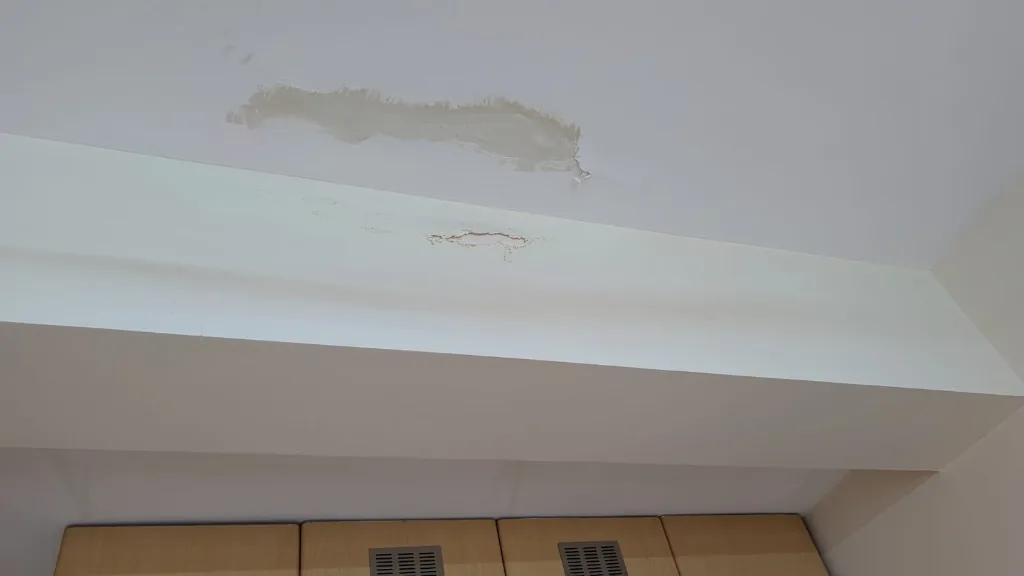
We recorded this pattern across multiple flats: ceiling beam soffits showing heavy dampness and blistered paint, drop beam delamination, and cracked wall-column junctions. Hollow sound and cracking were also found at three columns inside flats. These findings carry the Immediate Attention Required labels because the damage sits in load-carrying parts of the building.
Figure 1: Ceiling slab and drop beam dampness with plaster blistering from upper-floor plumbing seepage.
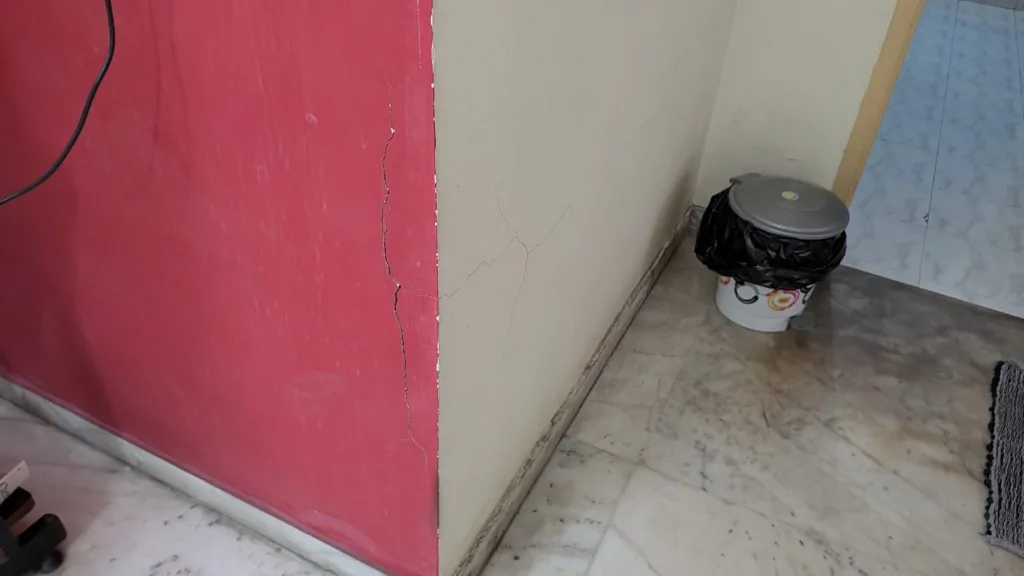
In addition to slab dampness, moisture tracking down structural interfaces led to progressive debonding along ceiling beams, as well as distinct vertical cracking along wall-column corner junctions where structural movement and moisture stress concentrate.
Figure 2: Distinct vertical crack along internal wall-column corner junction with secondary branching.Figure 3: Chronic moisture penetration and plaster delamination along ceiling beam soffit.
What We Found, Area by Area
The table lists the main findings with the priority labels exactly as they appear in the report.
Area
What we saw
Priority label
Toilet and utility plumbing
Corroded GI pipes, damp walls and ceilings, bulging wall tiles
Immediate Attention Required
Plumbing shafts
Leaking pipes, seepage into flats, lobby and ramp wall
Immediate Attention Required
Balconies and terrace
Leakage into ceilings and columns below
Immediate Attention Required
Columns in three flats
Cracks and hollow sound from long-term moisture
Immediate Attention Required
Slab edge, sunshades, lobby beam, ceilings
Concrete spalling and hollow sound
Immediate Attention Required
Switch boxes and light points
Moisture around electrical fittings
Immediate Attention Required
Small concrete pop-outs
Localised cover loss at a toilet, a lintel and a beam
Early Rectification
A/C drains and exterior walls
Water running down walls, thermal cracks
Early Rectification
Internal hairline cracks
Fine cracks in masonry walls and ceilings
Periodic Monitoring
Code-Compliant Remediation Sequence
The order of work matters. Repairing concrete before the leak is fixed means the same damage returns. Our report recommends this sequence.
01
Stop the water at its source
Replace the GI pipes in toilets and utility areas, repair leaking pipes inside the plumbing shafts, fix the moisture at switch boxes and light points, and have the wiring at those spots verified by an electrician. Give every A/C unit its own drain pipe.
02
Waterproof the wet areas properly
Waterproof toilet floors, the affected balconies and the terrace. Balcony drain pipes should be at least 2.5-inch for quick drainage, and the terrace needs proper slope and drainage so water does not stand.
03
Open up and clean the damaged concrete
Remove all loose and hollow concrete, then inspect the steel bars. Treat exposed reinforcement with an anti-corrosion primer, which slows further rusting.
04
Rebuild the concrete cover
Restore lost cover with structural repair concrete and replaster with polymer-modified mortar (PMM), a repair mortar with added polymers for better bond and lower water absorption. On sunshades, fill cracks and waterproof the top surface.
05
Strengthen the cracked columns
Once the moisture source is dealt with, repair the cracks and hollow zones at the three columns by concrete strengthening, after removing loose concrete and treating exposed steel.
06
Seal cracks and protect the walls
Cut cracks into a V-groove and fill them with non-shrink grout. Repair damaged elevation with PMM and finish the outside walls with a waterproof coating. Check the 2 mm east-wall cracks for depth and hollow sound before deciding their repair.
Preventive Pathology
Repairs fix today's damage. Regular care keeps it from coming back.
Periodic inspection. Have a structural engineer look over the building at planned intervals, including the shafts, terrace, sunshades and basement, and keep each report on file.
Regular maintenance. Check plumbing shafts and pipes regularly for damage, keep balcony and terrace drains clear, and re-coat waterproofing and exterior paint on schedule.
Monitor fine cracks. Thermal and hairline cracks can be filled and watched over time.
Control changes inside flats. Ask an engineer before altering walls, and avoid plant gardening inside flats, which the report links to water leakage.
This building shows how a few shared water sources can affect every floor over twenty years. The most urgent repairs are the leaking pipes and shafts and the few concrete members that already sound hollow. After that, the thermal and hairline cracks can be monitored. The long-term answer is the same for most apartment buildings: periodic inspection and routine maintenance, so small leaks are corrected before they reach the structure.
The inspection report
A visual inspection of a 20-year-old B+G+9 apartment building in Velachery covered 40 flats, common areas, basement and exterior walls. Hollow-sound checks supported the visual observations. No instrument tests were needed. The report records 65 observations, traces most dampness to corroded GI pipes, plumbing shafts, toilets, balconies, terrace and A/C drains, and advises repairs in a clear order, water first.
Redacted and watermarked. Includes 65 observations, site photos and recommendations.
Frequently Asked Questions
Why do many flats in the same building show dampness together?
Flats in a building share pipes, shafts, terraces and outer walls. When a pipe corrodes or a waterproof layer fails, water moves down through the floors, so flats stacked above one another show similar patches.
Can cracks near columns be filled and painted over?
Not on their own. If a column is cracked or sounds hollow because of moisture, the water source needs to be fixed first. The loose concrete is then removed, the steel is treated and the member is repaired or strengthened.
How often should an apartment building be inspected?
There is no single interval for every building. An engineer can suggest a schedule based on age, exposure and the building's condition. Buildings with a history of leaks benefit from a planned periodic inspection along with regular maintenance of pipes, shafts, drains and waterproofing.