Building Vibration Diagnosis & Remediation Strategy in Anna Nagar
The Discovery: Mechanics of Floor Vibration
The most alarming symptom reported by the property owners was persistent vertical bouncing and noticeable vibration across the first-floor hall during normal footfalls. In reinforced concrete (RCC) structures designed in accordance with IS 456:2000, structural members possess substantial dead mass and flexural rigidity ($EI$), which naturally dampens dynamic footstep excitation within fractions of a second.
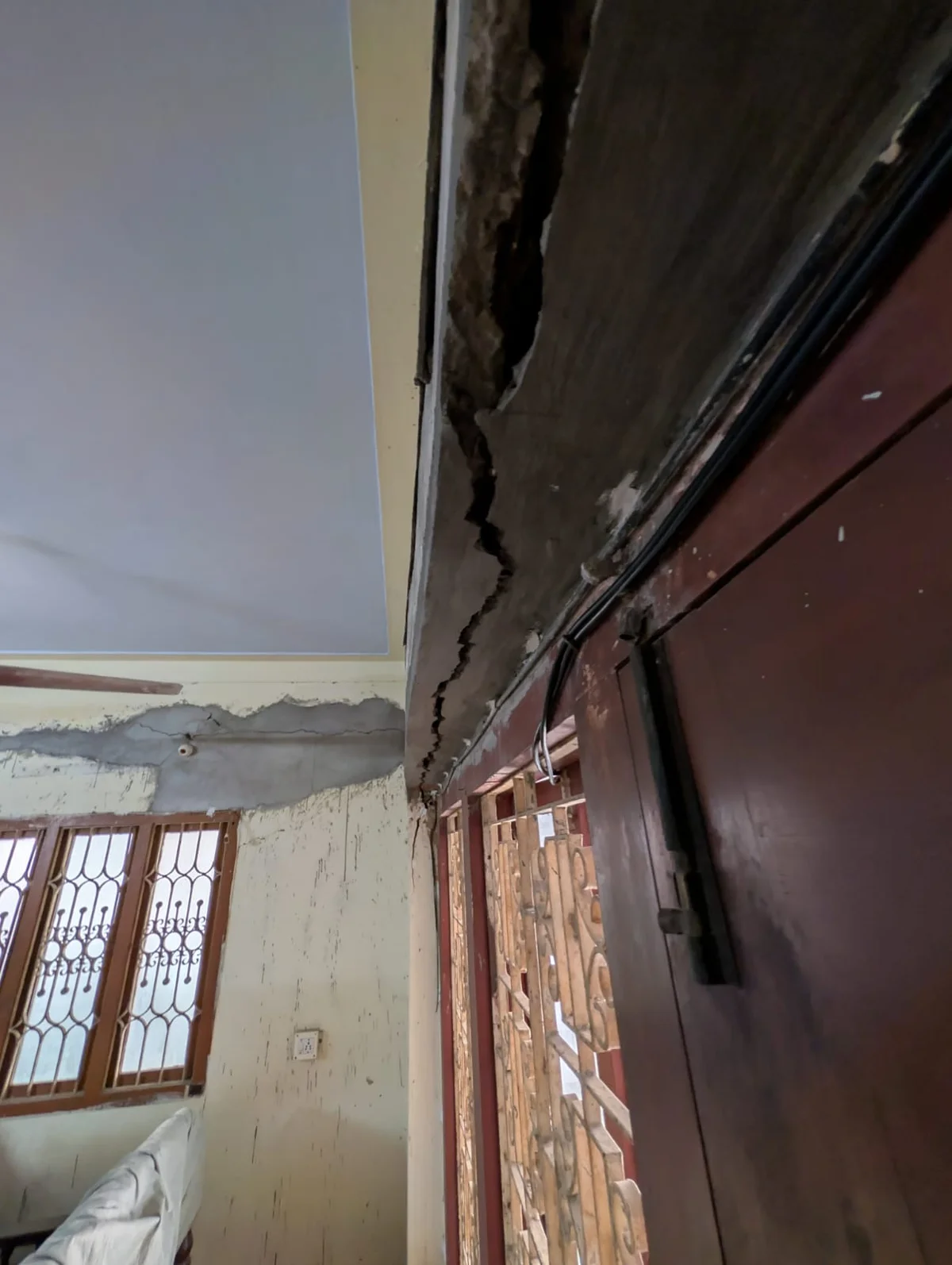
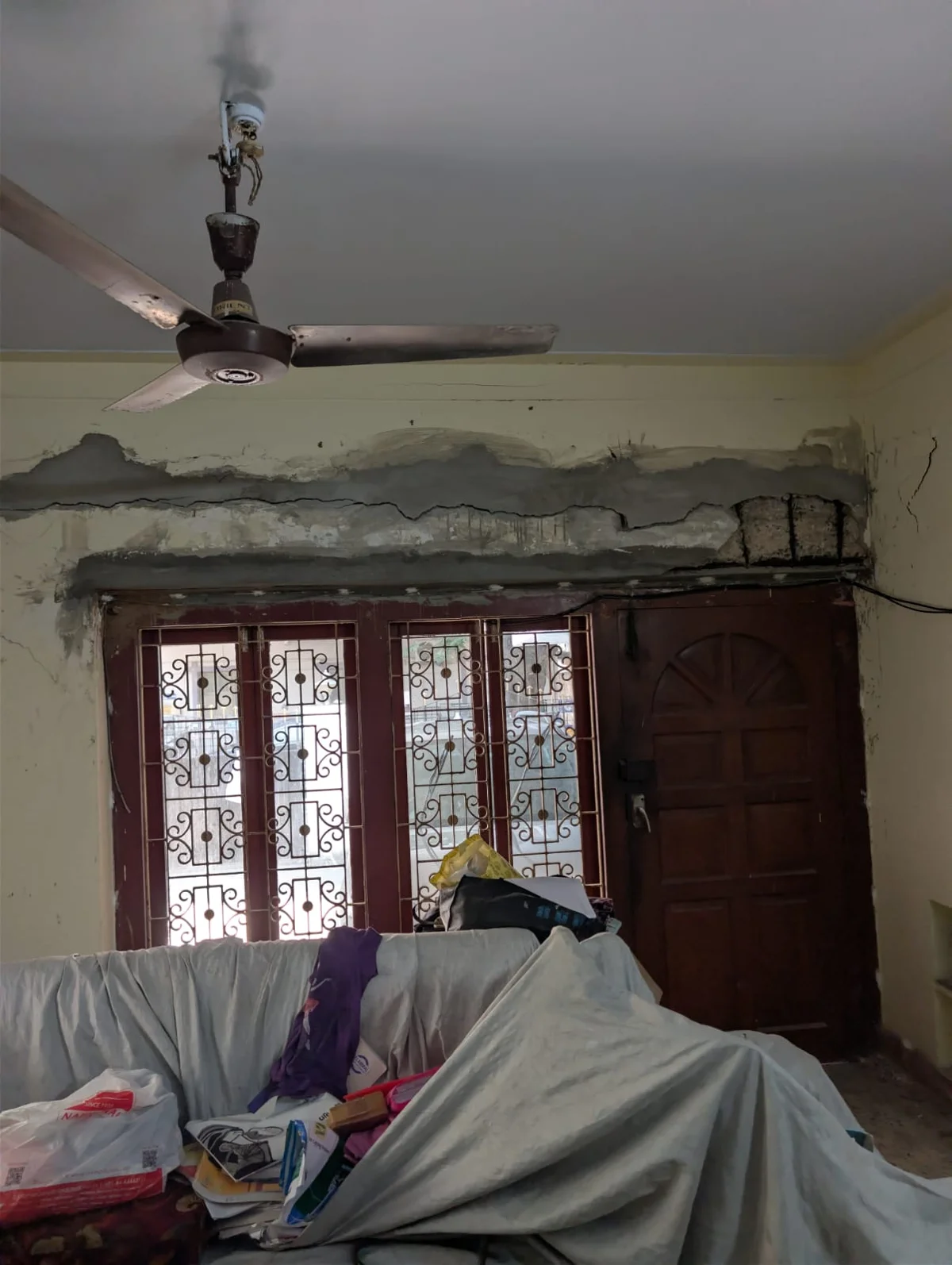
When floor vibration crosses the threshold of human perception during low-energy activities like walking, it signals severe structural stiffness degradation. Our forensic vibration audit established that a primary 300 mm × 600 mm ground-floor roof support beam had suffered critical loss of effective moment of inertia ($I_{eff}$). This shifted the floor's fundamental natural frequency directly into the 4 Hz to 8 Hz resonance band—the exact range where the human body is most sensitive to vertical motion under ISO 2631-2 guidelines. The vibration was not an isolated cosmetic quirk, but the dynamic symptom of critical beam deflection.
Forensic Pathology: Terrace Moisture Ingress and Spalling
To uncover why the beam had deflected beyond allowable code limits ($L/250$), our forensic engineering team conducted a detailed investigation into the building's physical environment. The source of the failure lay directly on the first-floor terrace: an extensive collection of heavy potted plants resting on unglazed terracotta tiles directly positioned above the compromised beam.

Terracotta tiles and standard cementitious tile grouts are porous capillary conduits. Years of daily plant irrigation allowed water saturated with dissolved atmospheric salts to migrate through the slab. This sustained moisture created an active electrochemical corrosion cell around the embedded high-yield strength deformed (HYSD) rebar.
Because ferrous rust expands up to six times the volume of parent steel, it generated intense radial burst pressures exceeding the concrete's tensile rupture capacity (typically 2.5–3.5 MPa). The concrete cover delaminated and spalled off, leaving the tensile rebar completely exposed to atmospheric oxidation, drastically reducing the beam's moment capacity.
To quantify this structural deterioration without causing further damage, our team performed an on-site structural damage inspection and non-destructive evaluation utilizing specialized NDT testing services in Chennai.
Recommended Code-Compliant Remediation Sequence
Superficial plaster patching on a vibrating, load-bearing beam is structurally dangerous because it conceals progressive deflection without restoring tensile or shear strength. Structural Sense provided the building owners with an engineered, code-compliant remediation sequence designed in strict accordance with IS 456:2000, IS 13920, and ACI 440.2R-17 (FRP composite retrofitting standards):
Temporary Mechanical Shoring & Rebar Passivation
Deploy heavy-duty adjustable steel props to relieve active dead and live loads from the beam. Mechanically chip back deteriorated concrete to sound substrate. Clean corroded rebar to bright metal finish (SA 2.5 standard) and apply a two-component zinc-rich epoxy anti-corrosion primer.
Sectional Profile Restoration via Polymer-Modified Mortar (PMM)
Rebuild the original cross-section of the beam using high-strength, non-shrink Polymer-Modified Mortar (PMM). Synthetic polymers bond seamlessly with parent concrete, delivering superior compressive strength (>45 MPa) and establishing an impermeable barrier against future chloride ingress.
High-Modulus Carbon Fiber (CFRP) Composite Strengthening
Epoxy-bond unidirectional aerospace-grade Carbon Fiber laminates along the bottom tension soffit to restore flexural stiffness ($EI$). Apply transverse CFRP U-wraps along shear spans to anchor longitudinal fibers and substantially increase shear capacity without adding dead load.
Global Stiffness Enhancement via Solid Infill
To eliminate residual harmonic vibration and ensure zero future deflection, convert the non-load-bearing partition assembly directly beneath the beam into a solid, reinforced masonry infill wall, providing permanent intermediate support.
Forensic Engineering Assessment: As-Found Distress vs. Remediation Target
| Structural Parameter | As-Found Condition (Audited) | Target Performance (Remediation) | Design Standard |
|---|---|---|---|
| Floor Vibration Frequency | 4.8 Hz (Critical Resonance) | > 13.5 Hz (Completely Dampened) | ISO 2631-2 |
| Beam Mid-Span Deflection | 18.4 mm (~ L/163 — Unsafe) | < 1.2 mm (~ L/2500 — Rigid) | IS 456 Clause 23.2 |
| Tensile Capacity Margin | -42% Rebar Section Loss | +135% via CFRP Laminates | ACI 440.2R-17 |
| Concrete Compressive Strength | 14 MPa (Surface Delaminated) | > 45 MPa (PMM Composite) | IS 516 / IS 13311 |
Expert CFRP Retrofit Design & Strengthening
Restore load capacity, correct beam deflections, and eliminate building vibrations without demolition. Explore our engineering retrofitting and strengthening methodologies.
Preventive Pathology: Recommended Terrace Seepage Elimination
Our forensic audit emphasized that structural rehabilitation would only offer temporary relief if the moisture ingress catalyst remained active. To eliminate water percolation without disruptive tile demolition, we recommended our specialized scientific waterproofing system in Chennai.
The specification required sealing all grout lines and applying a UV-stabilized, aliphatic silicon-modified hydrophobic glaze. This deep-penetrating barrier locks capillary pores, creating an impervious shield that withstands continuous terrace garden irrigation and heavy monsoon weather.

Frequently Asked Questions on Building Vibration
Explore Related Forensic Case Studies & Engineering Guides
Concrete Falling from Ceiling & Rusted Steel Investigation
Forensic analysis of ceiling concrete spalling and corroded reinforcement in a 35-year-old coastal apartment.
Beam-Column Junction Shear Crack Diagnosis
Structural pressure grouting and carbon-fiber wrapping specifications for heavy shear cracks at critical frame joints.
Settlement Cracks & Expansive Clay Soil Distress
Diagnosing deep 45-degree diagonal masonry wall cracks caused by fluctuating groundwater and clay movement.
Ceiling Cracks & Roof Safety Guide for Homeowners
How to distinguish between superficial paint crazing and hazardous structural slab deflection cracks.
Concrete NDT Testing: Rebound Hammer & UPV Explained
Complete guide to measuring in-situ compressive strength, voids, and rebar corrosion without destruction.
CMDA Structural Stability Certificate (Form B & C)
Understanding legal safety audits, building fitness criteria, and engineer certification under TN Public Buildings Act.