Dangerous Column Cracks: A Diagnostic Guide
The Pathology of a Failing Reinforced Concrete Column
Columns are the primary vertical load-bearing members of any structure. When a column cracks, it means internal stresses—whether generated by excessive dead/live loads, differential foundation settlement, lateral seismic forces, or chemical degradation—have exceeded the tensile or compressive capacity of the reinforced concrete matrix.
In coastal environments like Chennai, high atmospheric humidity and airborne chlorides accelerate concrete carbonation. When moisture penetrates the concrete cover, embedded steel rebar oxidizes and expands up to 6 times its original volume. This radial pressure splits the concrete open from within, causing severe cover spalling and rapid loss of axial load capacity. Ignoring these visual signals can lead to localized or progressive structural collapse.
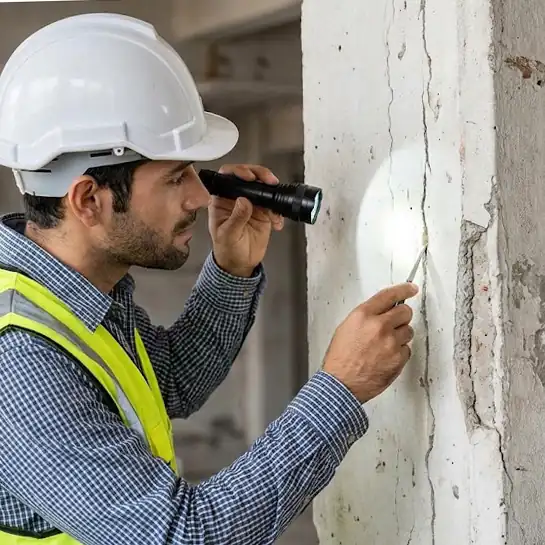
The Clinical Diagnostic Risk Matrix
Not all cracks behave identically. The angle, depth, width, and elevation of the fracture indicate the exact structural forces acting on the column. Compare your structural distress against this diagnostic matrix:
| Visual Pattern & Geometry | Engineering Pathology & Failure Mechanics | Risk Level |
|---|---|---|
|
Diagonal Cracks (45°) Steep angle across the column shaft |
Shear Failure / Differential Settlement: Indicates severe foundation movement, subsoil consolidation, or excessive lateral loads. The column core is experiencing severe shear slip. | Critical Emergency |
|
Horizontal Cracks Transverse fractures parallel to floor slab |
Flexural Bending / Overloading: The column is buckling under eccentric vertical loads or moment forces it was not designed to carry, causing tension failure on one face. | High Risk |
|
Vertical / Longitudinal Cracks Running straight up the column along rebar |
Carbonation & Rebar Corrosion (Spalling): Moisture and chloride ingress have corroded longitudinal steel. Rust expansion splits concrete cover away from the confined core. | High Risk |
|
Map / Web Hairline Cracking Fine, interconnected polygonal network |
Plastic Shrinkage / ASR: Surface-level micro-cracks caused during thermal curing or early-stage Alkali-Silica Reaction. Generally confined to the outer plaster layer. | Monitor Closely |
The 3-Step Forensic Investigation & Remediation Roadmap
Patching a structural crack with cosmetic cement plaster or surface putty is extremely dangerous; it conceals active distress while internal rebar corrosion and shear deformation accelerate unchecked. When a column exhibits High or Critical risk patterns, Structural Sense recommends the following 3-step engineering protocol:
Authorized Forensic Crack Audit & Distress Mapping
A professional site inspection by a CMDA Registered Structural Engineer to measure crack width using digital optical micrometers, map fracture trajectories, and evaluate global load paths under IS 456:2000.
Non-Destructive Testing (NDT) & Core Depth Profiling
Deployment of Ultrasonic Pulse Velocity (UPV) and Rebound Hammer testing to determine the internal depth of the fracture, assess concrete homogeneity, and quantify remaining uncracked core capacity.
Engineered Retrofitting Blueprint & Strengthening Specifications
Based on diagnostic data, the structural engineer formulates a surgical structural strengthening and retrofitting blueprint: high-pressure Epoxy Injection Grouting for monolithic bonding, CFRP Composite Wrapping for confinement, or Micro-Concrete Column Jacketing to upgrade axial and shear capacities.
Professional Structural Repair & Retrofitting Specifications
Do not risk progressive collapse. Discover our engineered repair methodologies—including micro-concrete jacketing, carbon wrap retrofitting, and epoxy injection grouting—to restore total load capacity.
Frequently Asked Questions on Column Cracks
Explore Related Forensic Case Studies & Engineering Guides
Concrete Spalling & Beam-Column Repair (35-Yr Old Building)
Forensic remediation of severe column cover loss and junction shear cracks in a 35-year-old apartment complex.
Building Vibration & Severe Beam Deflection Fix
Forensic NDT investigation and CFRP composite retrofitting specifications for a severe floor vibration issue.
Terrace Waterproofing Failure & Multi-Flat Damage
Comprehensive structural condition assessment of a 12-year-old apartment suffering cascading ceiling delamination.
Ceiling Cracks & Roof Safety Guide for Homeowners
How to distinguish between superficial paint crazing and hazardous structural slab deflection cracks.
Concrete NDT Testing: Rebound Hammer & UPV Explained
Complete guide to measuring in-situ compressive strength, voids, and rebar corrosion without destruction.
Stability Certificate for Old Buildings (30-Year Rule)
Statutory audit rules, redevelopment laws under TN Apartment Ownership Act 2022, and Form B compliance.