The Definitive Guide to Structural Stability in Chennai
The Statutory Roadmap: Step-by-Step Procedure
For commercial assets and public buildings, obtaining a stability certificate is a 5-step engineering journey. As a structural engineer with 19+ years of experience, I ensure this process is data-driven and legally compliant under the Tamil Nadu Public Buildings Act.
Authorized Field Audit
A comprehensive site inspection to map visible distress patterns and evaluate the building’s current structural geometry against original design intent.
NDT Forensic Investigation
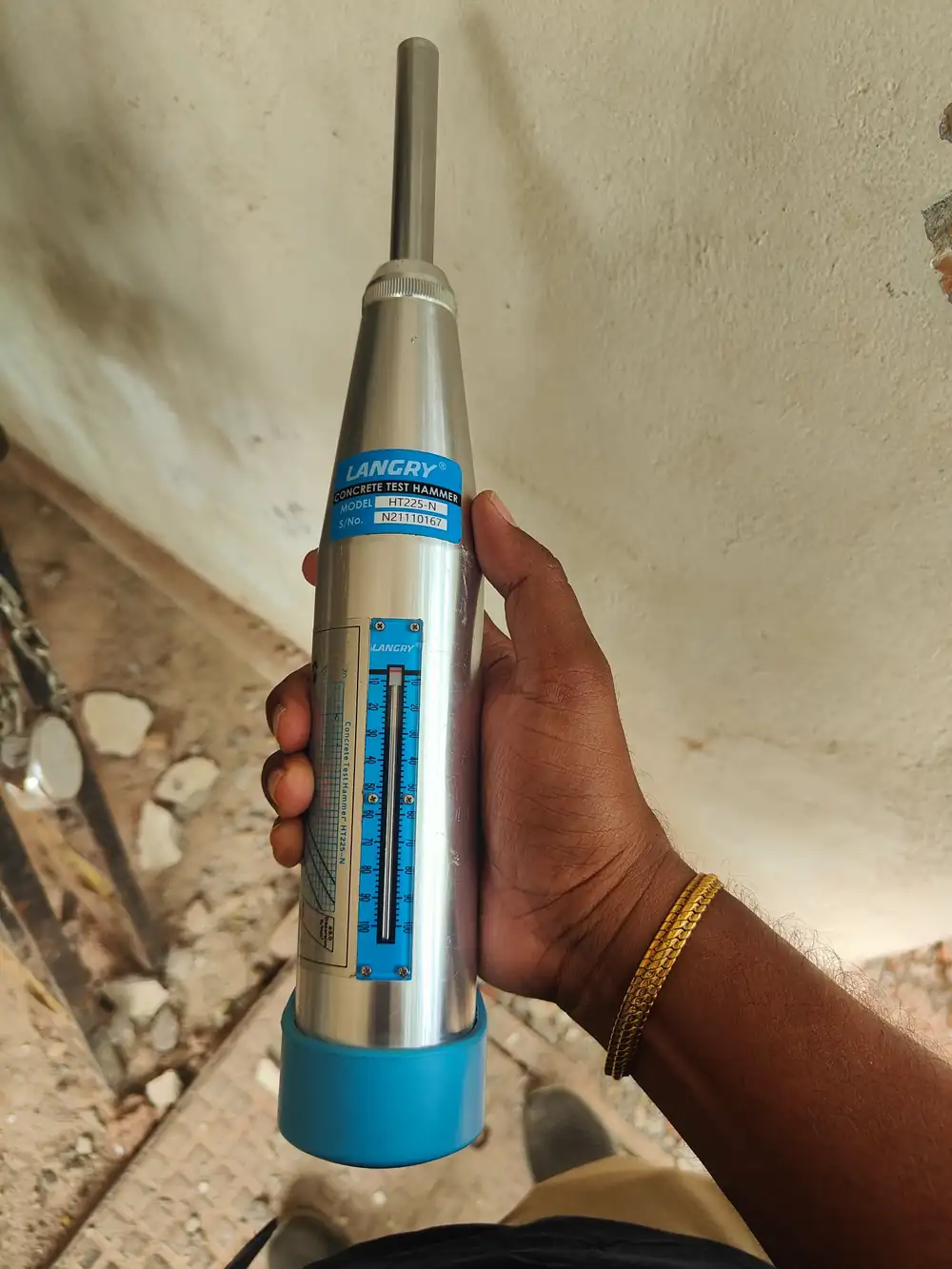
Deployment of specialized Non-Destructive Testing (NDT), including Ultrasonic Pulse Velocity (UPV) and Rebound Hammer analysis, to quantify the internal health of the concrete matrix.
Load-Path & Capacity Synthesis
Empirical field data is synthesized with mathematical modeling. We verify that the load-bearing members satisfy the safety criteria defined in IS 456:2000.
Issuance of Form B
Following successful validation, we issue the formal Form B (Certificate of Structural Soundness). This is the cornerstone document required for your building license.
Form C License Procurement
The Tahsildar or District Collector issues the final Form C license based on our engineering audit. We provide the technical evidence required to support this statutory filing.
The Role of NDT in Engineering Truth
Relying solely on visual observations is a breach of engineering protocol. We utilize Non-Destructive Testing (NDT) to identify "Structural Cancer"—internal rebar corrosion hidden behind plaster. Our protocol utilizes data-driven wave propagation and surface hardening metrics to prove stability.
Professional Site Inspection Audit
A comprehensive structural health investigation including crack grading, load-path verification, and statutory compliance mapping by an authorized structural engineer.