NDT Concrete Testing: The IS Code Guide
X-Ray Vision for Your Building
When buying a 20-year-old property, expanding your factory, or responding to CMDA municipal notices, visual observation alone cannot verify internal strength. The concrete might look solid on the outside, but the internal rebar could be destroyed by coastal corrosion, or the core might be riddled with microscopic voids.
Non-Destructive Testing (NDT) strictly governed by IS 13311 (Parts 1 & 2), allows us to forensically scan the internal geometry of the RCC framework to determine if it is safe to occupy or expand.
NDT IS Code Estimator [2026]
Premium NDT testing requires highly calibrated equipment and strict grid-based sampling. Use this dashboard to input your building size. The algorithm will calculate the minimum IS Code sample size required and generate an estimated forensic testing fee.
Forensic Diagnostic Estimator
Live 2026 Testing Metrics based on IS 13311
Engineering Prerequisite
Testing random columns provides useless data. A mandatory ₹5,900 Site Inspection Audit must be completed first to map the load path and determine exact sample locations.
The Three Core NDT Methodologies
Depending on what our visual audit discovers, we deploy specific acoustic or electro-chemical technologies to map the internal decay mathematically.
Rebound Hammer (IS 13311 Part 2)
Use Case: Compressive Strength. This spring-loaded device impacts the surface of the concrete. By recording the "rebound number" and comparing it to calibrated curves, we accurately estimate if your column still holds the M20 or M25 grade strength required to support the building.
UPV Testing (IS 13311 Part 1)
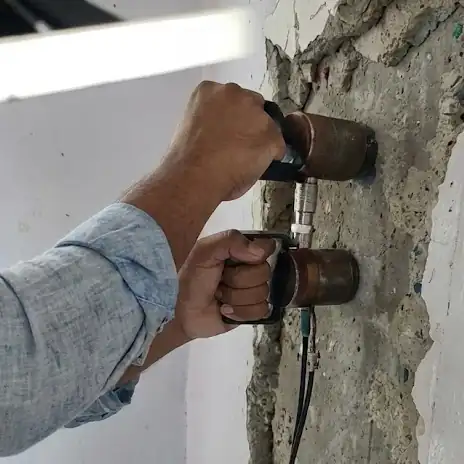
Use Case: Internal Voids & Cracks. We place acoustic transducers on opposite sides of a column and shoot high-frequency ultrasonic waves through it. Sound travels fast through solid concrete. If the velocity drops, we instantly know the core is compromised by honeycombing or micro-cracks.
Half-Cell Potential Profiling
Use Case: Rebar Corrosion (Rust). When steel rusts inside concrete, it generates a microscopic electrical current. By pressing a sensitive copper-sulfate electrode against the column, we map the exact locations where the internal rebar is actively decaying long before spalling occurs.
The Order of Operations
You cannot simply "order" an NDT test. To ensure compliance and accuracy, the process must follow a strict engineering timeline.
1. Phase One: The Visual Audit
Book a ₹5,900 Site Inspection. Our engineers will physically map your building's load path, identify structural stress points, and formulate a targeted NDT testing grid.
2. Phase Two: Retrofitting Solutions
If the NDT mathematical results show critical weakness, engage our execution team to perform micro-concreting, CFRP wrapping, and permanent structural retrofitting.