Dangerous Column Cracks: A Diagnostic Guide
The Pathology of a Failing Column
Columns are the primary vertical load-bearing members of any structure. When a column cracks, it means the internal stresses—whether from excessive loads, soil settlement, or chemical decay—have exceeded the tensile or compressive capacity of the concrete. Ignoring these visual signals can lead to localized or progressive structural collapse.
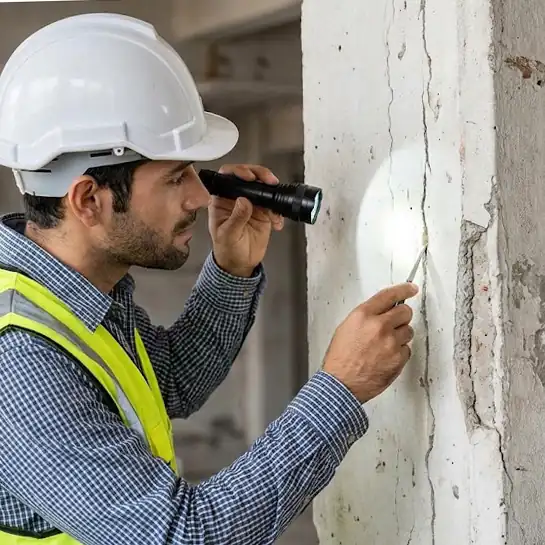
The Diagnostic Risk Matrix
Not all cracks behave the same way. The angle, depth, and location of the fracture tell a Structural Engineer exactly what forces are destroying the column. Compare your structural distress against this clinical matrix:
| Visual Pattern | Engineering Pathology | Risk Level |
|---|---|---|
| Diagonal Cracks (45-degree angle across the face) |
Shear Failure / Settlement: Indicates foundation yielding, soil liquefaction, or excessive lateral loads. The column is tearing itself apart. | Critical Emergency |
| Horizontal Cracks (Parallel to the floor) |
Flexural Bending / Overloading: The column is buckling under a vertical load it was not designed to carry, causing tension failure on one side. | High Risk |
| Vertical/Longitudinal Cracks (Running straight up the column) |
Carbonation & Corrosion: Moisture has penetrated the concrete cover, rusting the rebar. The rusting steel expands, splitting the concrete open (Spalling). | High Risk |
| Map / Web Cracking (Fine, interconnected hairline cracks) |
Plastic Shrinkage / ASR: Generally caused during the curing process or by Alkali-Silica Reaction over time. Usually shallow. | Monitor closely |
The Remediation Roadmap
Patching a structural crack with cement or putty is cosmetic camouflage; it does not restore the lost load-bearing capacity. If your column exhibits High or Critical risk patterns, you must execute this engineering protocol immediately:
Authorized Crack Audit
A professional site inspection to measure crack width using digital gauges and trace the load-path failure.
NDT Depth Profiling
Deployment of Ultrasonic Pulse Velocity (UPV) to determine how deep the crack penetrates the core of the column.
Structural Retrofitting Design
Based on the data, an engineer will design a surgical intervention—such as Epoxy Injection, Carbon Fiber (CFRP) Wrapping, or Micro-concreting (Jacketing).
Structural Repair & Retrofitting
Do not wait for progressive collapse. Discover our engineered repair methodologies, including CFRP wrapping and epoxy grouting, to restore your asset's strength.