Can Your Old House Support Another Floor? The Vertical Expansion Guide
The Physics of Vertical Expansion
Local masons often claim, *"The columns look thick enough, it will be fine."* This is a dangerous gamble. Adding a new 1,000 sq.ft floor forces the existing ground-floor columns and footings to carry an additional 60 to 80 tonnes of dead weight. If the original foundation was not engineered for a G+1 or G+2 structure, the new load will cause immediate shear cracking and foundation settlement.
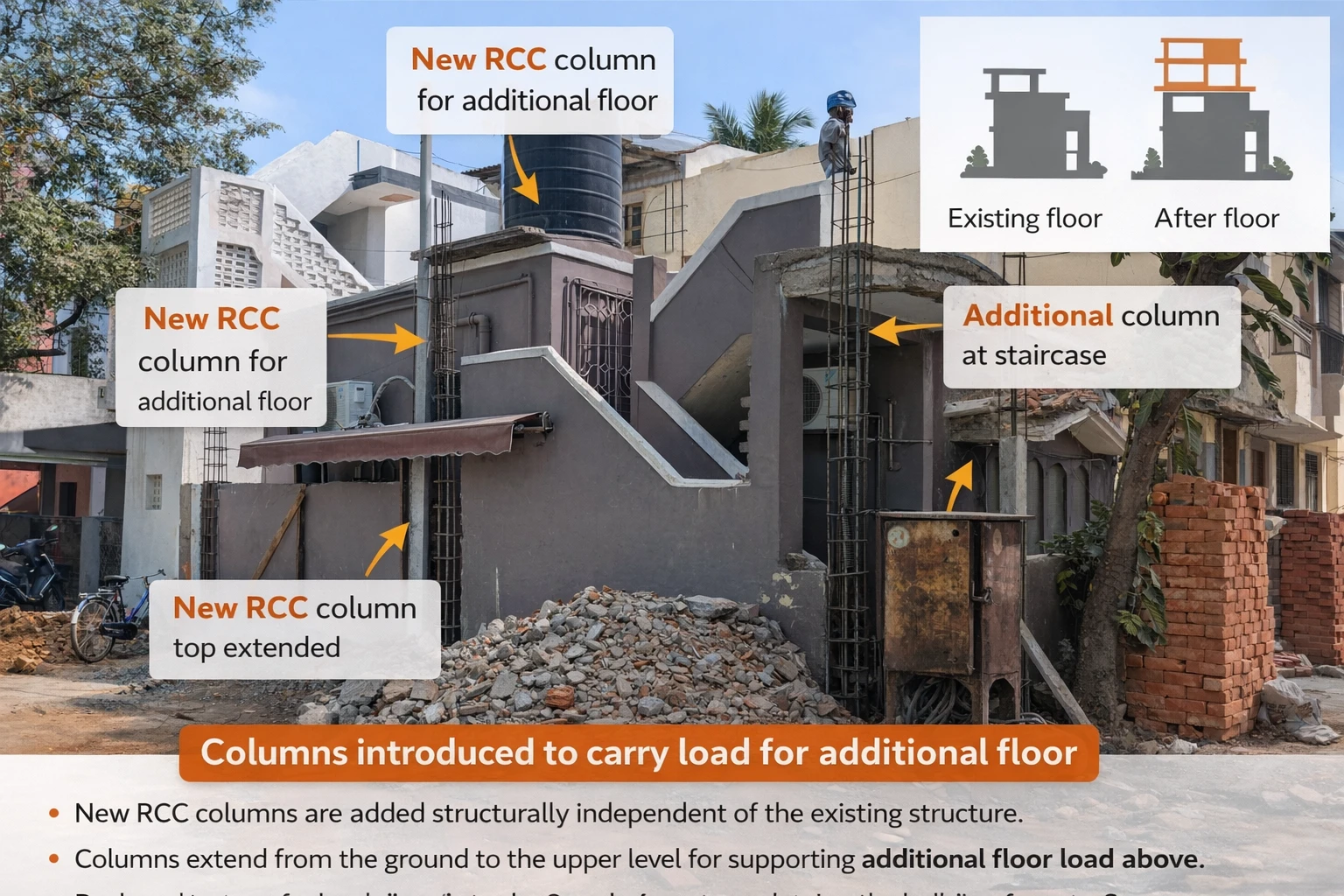
The Structural Load Verification Matrix
To guarantee the safety of your family and your investment, we deploy a strict mathematical verification protocol before approving any vertical expansion.
| Structural Element | Engineering Diagnostic Tool | What We Are Testing For |
|---|---|---|
| Existing Columns | Rebound Hammer / Core Testing | Verifying if the 20-year-old concrete still possesses the required M20 compressive strength to carry the new floor. |
| Internal Rebar | Cover Meter / Rebar Profiling | Checking the diameter of the existing steel (e.g., 16mm vs 12mm) to ensure it can handle the new bending moments. |
| Foundation / Footing | Load-Path Calculation (STAAD) | Calculating if the existing soil (SBC) and footing size will sink under the added weight. |
The 2026 Assessment Cost Matrix
Do not risk a ₹30 Lakh construction project without spending a fraction of that on structural validation. Furthermore, Chennai's municipal bodies (CMDA/GCC) mandate a Stability Certificate for floor additions.
| Assessment Tier | Engineering Scope | Professional Fee |
|---|---|---|
| Professional Site Inspection | Visual audit, load-path mapping, crack grading, and blueprint review to determine base feasibility. | ₹5,900 (Incl. GST) |
| NDT Concrete Diagnostics | Deployment of UPV or Rebound Hammer to verify the existing concrete's internal compressive strength. | Quoted Post-Inspection |
| New Floor Structural Design | Full IS-Code compliant structural drawings for the new roof slab, beams, and columns. | Based on Built-Up Area |
Value Engineering: What if the old house is weak?
If our NDT tests reveal that your ground floor columns are marginally weak, you do not have to abandon your expansion plans. As a Structural Engineer, I utilize modern value engineering to bypass these limitations.
Lightweight Dead-Load Design
Instead of heavy red bricks, we redesign the new floor using AAC (Autoclaved Aerated Concrete) blocks. This instantly strips up to 30% of the dead weight off the old ground-floor columns.
Steel Roof Alternatives
If the foundation cannot support a heavy 6-inch RCC concrete slab, we can engineer a premium insulated steel-framed roofing system, drastically lowering the load while maintaining aesthetics.
Column Jacketing (Retrofitting)
If the columns are critically weak, we can mathematically design a "Carbon Fiber Wrap" (CFRP) or micro-concrete jacket to artificially boost the compressive strength of the old columns before building the new floor.
Professional Structural Audit
Before you hire a contractor to add a floor, book a ₹5,900 Site Inspection Audit. Let us mathematically verify your building's safety and provide the mandatory stability certificates.